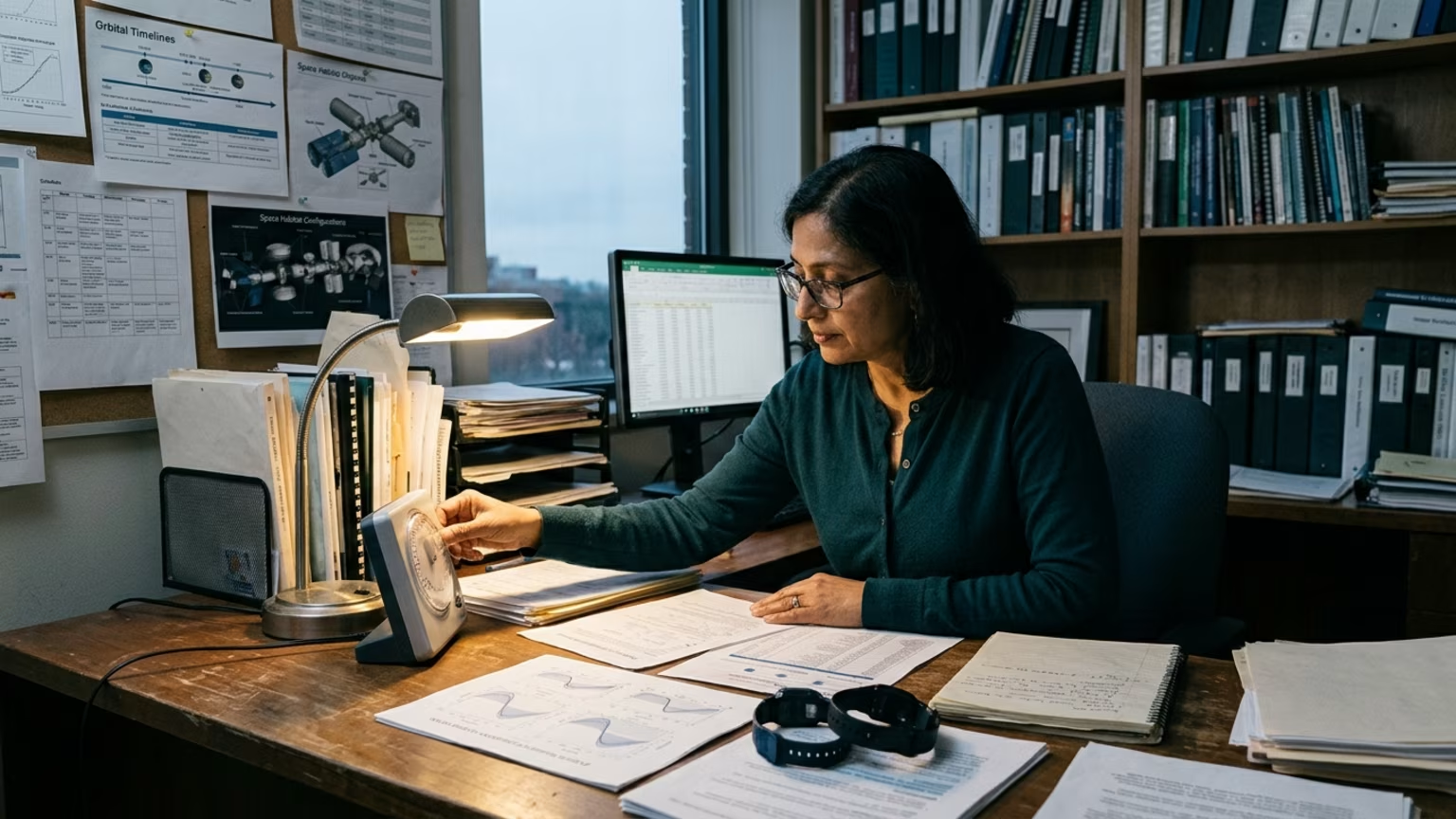

Spaceflight research highlights timed light and coordinated routines, offering a measured perspective on sleep readiness and daily recovery after 35.





On October 2, 2026, The Conversation published Ronan Lordan’s feature on sleep and circadian rhythms in space. Republished by Phys.org, it described research into timed light and coordinated daily schedules when natural day-night cues become unreliable.
The feature’s central point is that exhaustion and biological readiness for sleep are not the same thing. Making room for sleep matters, but the body’s internal timing also influences whether that opportunity becomes actual rest. Spaceflight makes the distinction unusually visible.
According to The Conversation, an Earth-orbiting spacecraft completes an orbit roughly every 90 minutes. Astronauts can experience about 16 sunrises and sunsets in a 24-hour period. That sequence makes natural light an unreliable guide to when the waking day should end.
The feature says astronauts have traditionally been allotted about 8.5 hours for sleep each day. Research across missions suggests they often obtain less actual sleep than that allowance. It also reports an association between six hours or less of daily sleep and measurable reductions in vigilant attention in ISS research.
For readers on Earth, the useful distinction is between having time available for sleep and having daily cues that fit that time. A bedtime on the calendar describes an opportunity. It does not describe everything affecting sleep readiness.
Lordan describes sleep as shaped by two interacting processes. Sleep pressure builds during time awake and dissipates during sleep. The circadian clock influences when sleep is biologically expected.
These processes help explain the feature’s example of an exhausted astronaut whose internal clock is still signaling daytime. Feeling worn out does not mean both systems are pointing toward sleep at the same moment. Fatigue alone is therefore an incomplete account of sleep readiness.
This offers a less blaming way to think about a familiar midlife concern: feeling tired while still feeling unable to settle. The research framing shifts attention away from trying harder to sleep. It directs attention toward the relationship between accumulated tiredness and the timing signals surrounding the planned sleep period.
The Conversation describes blue-enriched white light as potentially useful during scheduled waking hours for alertness and circadian synchronization. Before sleep, the feature describes dimmer light with less blue content as a different kind of cue. The distinction concerns when light is used, not simply whether blue light is present.
The report also describes coordinated exercise, meals, tailored lighting and work schedules as ways to help offset some effects of sleep loss and circadian disruption in spaceflight. In this account, lighting sits within the daily schedule rather than acting as a separate solution.
There is also an operational trade-off. The Conversation reports that NASA-supported lighting testing found greater melatonin production under presleep lighting but impaired color discrimination. That could complicate tasks involving color-coded controls or warnings.
The practical lesson is broader than choosing a light color. A lighting arrangement must fit both the intended sleep-wake period and the work someone still needs to do under it.
This was a research feature about an unusual environment, not a clinical trial in adults navigating midlife. It does not identify the underlying papers or provide enough detail to independently assess the reported ISS sleep-attention association and lighting test. The attention finding is an association rather than proof that sleep duration alone explains the difference.
The astronaut sleep figures describe traditional allowances and findings across missions, not a universal astronaut schedule. The feature also supplies no specific home light levels, exposure durations or universal schedule for insomnia or shift work. Its account does not establish dimmer or blue-depleted lighting as an insomnia treatment.
These limits leave a modest practical implication: examine how light and daily routines align with planned waking and sleeping periods. Personal decisions involving persistent sleep difficulties, medical conditions or atypical schedules belong with a qualified clinician.
For adults aged 35 to 65, the most useful adjustment suggested by this account is a review of the daily pattern rather than a new recovery regimen. The question is whether the environment supports the intended waking period and then changes as the planned sleep period approaches.
That review can stay simple. It does not need to become another score to improve or another task competing with work and caregiving. The focus is the fit between daily cues and the schedule someone is trying to keep.
The feature places brighter, alerting light within scheduled waking hours. For an adult balancing work and family responsibilities, that makes the whole waking period relevant to the discussion rather than bedtime alone.
A practical reflection is to notice where the day’s strongest light occurs. Does it belong mainly to the period set aside for being awake, or does the brightest environment arrive close to planned sleep? This is a way to identify the pattern before deciding whether any change is needed.
Relaxopia’s explanation of how everyday timing cues work together provides related context. The point here is coherence across the day, not finding a single perfect moment for light exposure.
The spaceflight approach described in the feature uses dimmer, blue-depleted light before sleep. An everyday application is to look at whether the lighting remains set for active work after the intended wind-down period has begun.
That does not make darkness the goal. The reported color-discrimination trade-off shows why lighting decisions also need to account for visibility and the task at hand. Finishing an activity that requires accurate recognition of color-coded information is a different situation from sitting quietly before bed.
For related reading, Relaxopia’s coverage of daytime brightness and evening light patterns places those choices within a wider daily rhythm. A useful lighting adjustment should fit real responsibilities rather than create a conflict with them.
Lordan’s account does not treat light as the only relevant part of the schedule. Meals, exercise and work are also included in the coordinated approach described for spaceflight.
For a midlife adult, the practical translation is to view these activities together. A sleep plan can include a clear bedtime while leaving the surrounding day largely unexamined. Looking at the broader sequence makes the discussion about daily organization rather than a final effort to switch off at night.
The review can begin with ordinary observations: when work ends, where meals fall and how activity fits around the intended sleep period. The aim is to understand the existing pattern before adding another rule. Relaxopia’s guide to the relationship between daily energy and recovery offers a broader framework for that reflection.
For someone managing an already demanding week, understanding the pattern is a useful first outcome. It keeps attention on the relationship between routines and rest without making every evening a test of perfect behavior.
The feature identifies NASA’s Artemis Research for Crew Health and Readiness study as an effort to examine sleep and activity before, during and after Artemis II. Its remit also includes cognition, behavior and team performance. According to the account, crew members wore wrist-mounted movement and sleep monitors.
The Conversation also discusses NASA’s yearlong CHAPEA Mars simulation. A Martian sol lasts approximately 24 hours and 40 minutes, creating another setting for studying adaptation to a different daily cycle. The feature reported that the four-person crew was scheduled to move to Martian time in late September 2026.
Together, these research settings put sleep timing alongside the ability to function during waking hours. For everyday recovery, that is a useful direction for future questions: not only how a schedule looks on paper, but how well rest and daytime demands fit together.
Could future studies show whether more coherent light and activity cues improve long-term recovery in midlife without making rest another demanding task?
Sleep timing and daytime alertness give light research a practical focus; Relaxopia turns credible evidence into clear explanations about the habits shaping rest. Confusion about daytime brightness and presleep lighting is met with guidance that helps adults 35+ understand circadian timing without adding unnecessary complexity to their routines.
Stay connected for research-led guidance on sleep quality, stress, circadian rhythm, recovery, fatigue and everyday energy. Clear ideas for adults 35+ who want to sleep better, recover more fully and feel more capable through the day.




Explore practical guidance on sleep, stress and recovery without chasing every new hack, device or promise.
explore the blog