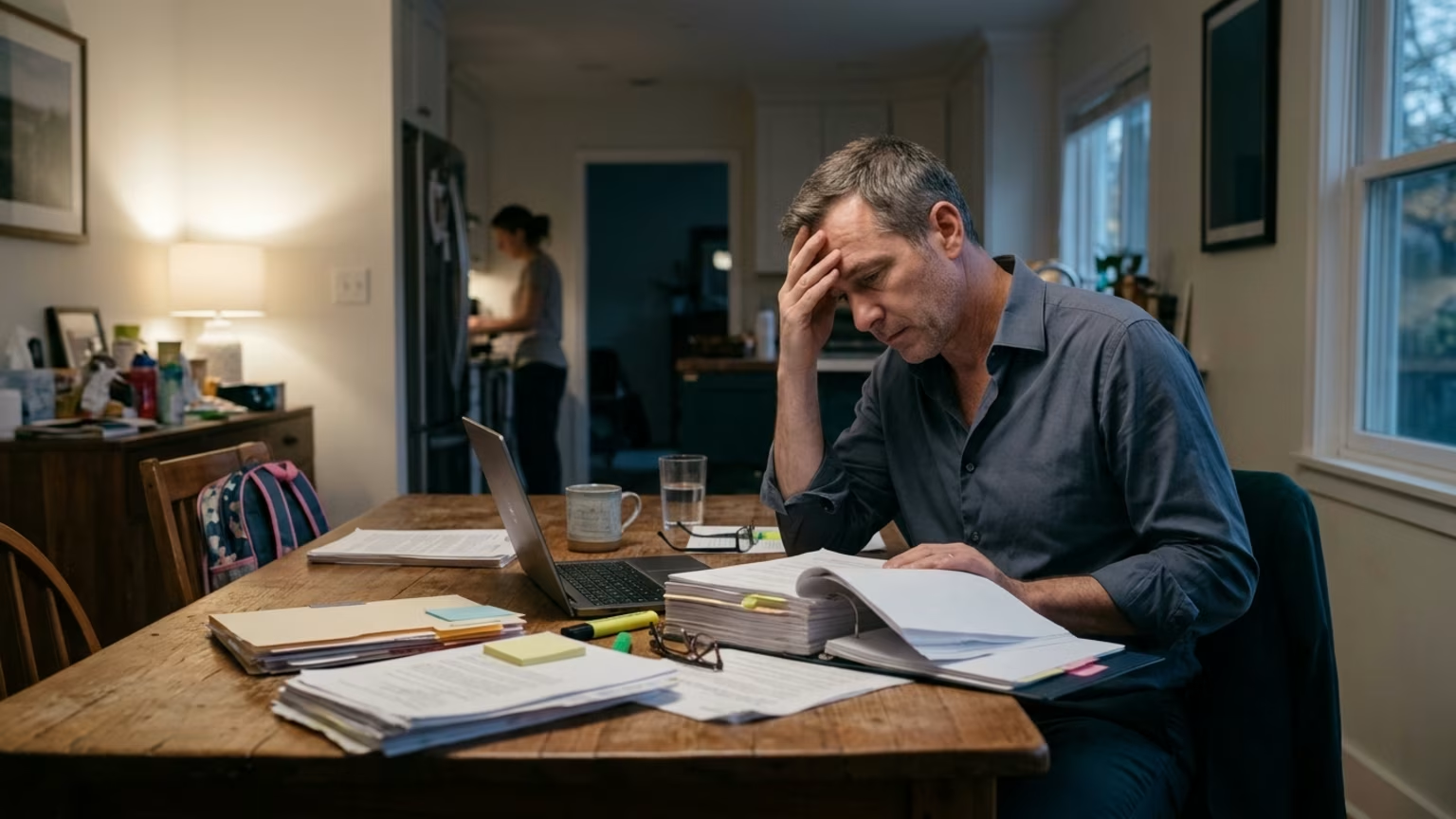

A large U.S. lawyer study links burnout and work-home conflict with distress, offering a measured way to rethink midlife recovery.





On October 2, 2026, the University of Minnesota Medical School reported on research linking burnout and work-home conflict with distress among U.S. lawyers. Published in the Journal of Affective Disorders in 2026, the study analyzed responses from more than 39,000 working lawyers.
Researchers Justin Anker and Patrick Krill titled their study When demands equal distress: An updated understanding of lawyer mental health and well-being. Its focus was not simply how many lawyers felt unwell, but how reported distress related to the structure and demands of their working lives.
Burnout was closely tied to psychological distress in this study. Lawyers reporting more conflict between their professional and home lives also reported greater distress, including after researchers accounted for burnout. According to the University of Minnesota report, that makes work-home conflict a distinct part of the findings rather than a passing detail.
The central message is not that lawyers need to become better at tolerating pressure. It is that the conditions surrounding work belong in the discussion of mental health. Co-author Justin Anker interpreted the findings as linking distress with measurable features of work, including demands and practice setting.
For a midlife reader trying to understand why recovery feels difficult, this shifts the question. Instead of asking only whether a wind-down routine is good enough, it makes room to ask what work is carrying into home life. That is an editorial takeaway from the pattern in the study, not a judgment about anyone's coping skills.
According to the Pennsylvania Disciplinary Board, the survey received 39,306 responses from actively licensed lawyers in 28 participating jurisdictions. Of those responses, 36,925 were eligible for weighting. The University of Minnesota report says invitations were random across U.S. regions and results were weighted to national age, gender and race/ethnicity benchmarks.
The board reported high or very high work-related burnout in 47.5% of respondents. The University of Minnesota described the research as the profession's first large-scale estimate of burnout.
Both summaries reported moderate-or-higher symptom levels:
The board also reported that 41.8% screened positive for hazardous drinking. High or very high conflict between professional and personal or family life was reported by 35.9%.
The figures also describe different parts of the picture. Burnout is not being used here as a substitute name for depression symptoms or hazardous drinking. Reading each measure separately preserves the study's distinction between work-related strain and the other concerns assessed.
These results put work-home conflict alongside burnout and other forms of distress in the same research picture. They give the profession several connected concerns to examine rather than a single score to improve.
The Pennsylvania Disciplinary Board's account reported greater distress and burnout in solo practice and private firms, particularly among litigators. The comparison groups included lawyers working in in-house, judicial or academic roles.
It also reported substantially higher stress and burnout risk among lawyers working more than 70 hours a week than among those working a standard 40-hour week.
Those patterns make the setting of work relevant to the conversation. A discussion focused only on personal toughness would leave out the differences the researchers observed across professional circumstances.
The setting comparisons are useful because they keep the discussion specific. Lawyers share a profession, yet the reported findings varied across ways of practicing it. The results point toward questions about how work is organized, not merely how an individual handles a demanding occupation.
For readers outside law, the useful question is about context: which demands are present and where do they spill over? That approach helps with sorting different sources of workplace pressure without assuming that every demanding job presents the same challenge.
Separate reporting adds a sleep-related concern. In its September 23, 2026 report, Bloomberg Law described a survey of roughly 1,150 attorneys conducted in summer 2026. Nearly half said their well-being had worsened since the start of 2025.
Respondents reporting worsening well-being were also more likely to report work-related anxiety and depression, physical problems and disrupted sleep.
That adds a reason to keep sleep within a broader conversation about working life. For a reader who feels unrested, it also offers a more useful frame than treating the bedroom as the only place where recovery questions belong.
The main study was cross-sectional, meaning it captured a snapshot in time. It cannot establish whether burnout contributed to distress and hazardous drinking or whether the relationship ran in the opposite direction. Other factors could influence both.
The percentages describe screening results and symptom levels, not individual diagnoses. The research concerns U.S. lawyers and does not establish prevalence for other professions or adults aged 35 to 65.
The large sample and demographic weighting strengthen the study's reach. However, the available reports do not provide a response rate or enough information to independently assess nonresponse bias. The reported working-hours comparison also lacks an effect size, so it does not quantify how much risk differed.
The Bloomberg Law survey used a different sample and time frame. It should be read as separate context rather than a replication of the larger study.
Neither survey tested whether a sleep habit or resilience practice prevents burnout. The practical ideas below are ways to think about workload and support, not a treatment protocol established by these findings.
For an adult aged 35 to 65, a modest adjustment is to broaden an existing end-of-work reflection. Alongside noticing personal strain, include the work conditions that may be making it harder to recover. No additional recovery score is needed.
The questions can stay close to the study's themes:
These questions separate the experience of strain from the circumstances around it. They also make room for a more specific conversation than simply deciding to be more resilient.
If work repeatedly takes over personal time, workload expectations and work-home boundaries are relevant subjects for discussion. Depending on the situation, that discussion might involve a manager or another appropriate workplace contact. The point is to name the condition being questioned rather than assume the entire answer is a better evening routine.
A concrete discussion could stay with the concern already identified: the volume of work, the expectation that work enters personal time or uncertainty about where to seek support. It need not begin with a label for the person's mental health. The study's workplace focus provides a vocabulary for raising those issues.
Personal habits need not disappear from the picture. A question about which bedroom issue to address first still belongs in a sleep discussion. It simply answers a different question from whether work demands are crowding out home life.
For readers juggling professional and family responsibilities, this distinction can keep the focus practical. A routine is one topic. The demands placed on someone's time are another. Both can be discussed without treating fatigue or distress as evidence of personal failure.
That is also a more balanced basis for approaching strain without self-blame. The aim is not to create another daily task to perform correctly. It is to make working conditions visible when thinking about recovery.
The University of Minnesota report says 53% cited confidentiality concerns as a barrier to seeking help. Possible career impact was cited by 49%.
Those findings make privacy part of the practical conversation. They do not mean every support option has the same protections or the same implications.
Access is therefore not only a question of whether someone is willing to ask for help. The concerns respondents reported also make it relevant to ask what information a support option provides before personal decisions are made.
If symptoms are persistent or worsening, seeking qualified professional support is a reasonable next step. Questions about who can access information and how confidentiality works can be discussed directly with the service or clinician. Workplace support and clinical care should not simply be assumed to operate under identical arrangements.
Knowing what a service says about access and privacy is more useful than guessing. This keeps the discussion focused on an identified concern in the study while leaving personal care decisions with a qualified professional.
The University of Minnesota report says future work will develop and test interventions aimed at reducing burnout and work-life conflict. That is the next step beyond describing how these experiences cluster.
Co-author Patrick Krill described the research as clarifying relationships between professional demands and distress and hazardous drinking, with the potential to guide improvements.
For midlife recovery, the valuable test is whether changes directed at working conditions produce meaningful improvements in people's well-being. It would move the conversation from recognizing an association toward evaluating what actually helps.
If work-home conflict remains a target in that research, could long-term approaches to midlife recovery give working conditions the same attention they give individual habits?
Work-home pressure leaves employees and their teams with daily decisions; Relaxopia brings research-led explanations to that discussion. For adults 35+ receiving conflicting advice about routines and sleep environments, its coverage places those choices alongside stress and recovery without adding a demanding new regimen to daily life.
Stay connected for research-led guidance on sleep quality, stress, circadian rhythm, recovery, fatigue and everyday energy. Clear ideas for adults 35+ who want to sleep better, recover more fully and feel more capable through the day.




Explore practical guidance on sleep, stress and recovery without chasing every new hack, device or promise.
explore the blog