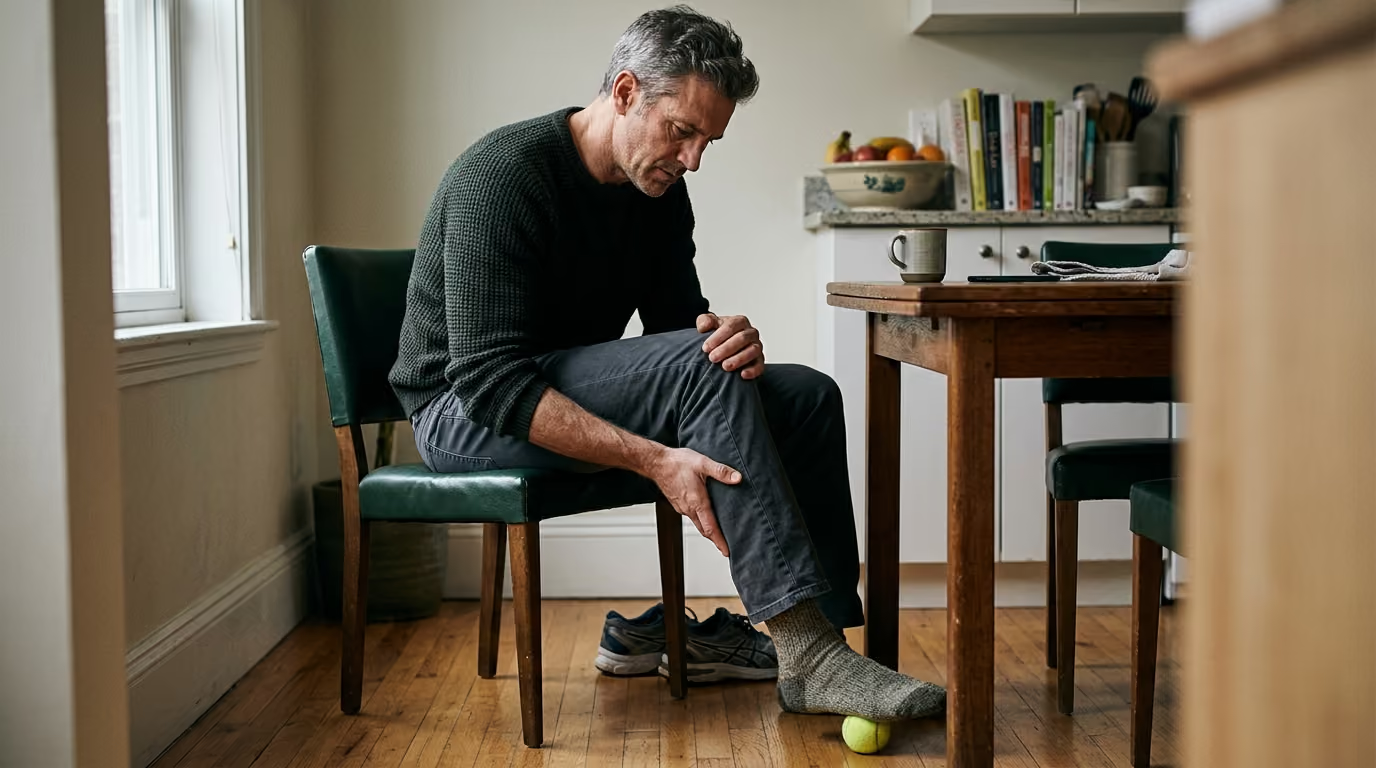

Sleep perfectionism often sabotages natural rest, but practical behavioral adjustments and realistic tracking habits can help you restore genuine nighttime recovery.





Working harder at sleep is often the exact reason rest slips away. Most health goals reward discipline, rigorous tracking, and strict execution. Sleep does the opposite. When you treat bedtime as an athletic performance or a project to complete, you invite mental alertness into a biological process that demands surrender.
Many adults who set out to fix their fatigue find themselves caught in an exhausting cycle of optimization. They measure every minute of sleep, curate strict evening routines, and worry about arbitrary recovery scores. This guide examines why sleep perfectionism backfires, what current research reveals about sleep data, and how to build a calmer relationship with rest.
Sleep perfectionism occurs when the pursuit of healthy rest shifts into rigid control, constant monitoring, and unrealistic expectations. It transforms a natural recovery state into a high-stakes test. When bedtime is treated like an assignment, normal fluctuations in rest begin to feel like personal failures.
A specific manifestation of this pattern is orthosomnia. The term comes from the Greek roots for correct and sleep. It was first described in clinical literature by researchers studying patients whose fixation on wearable data worsened their insomnia symptoms. These individuals spent hours analyzing nightly metrics, attempting to engineer ideal sleep stages to improve their daytime performance.
Research shows that anxiety around sleep data is remarkably common. A systematic review published on orthosomnia screening tools found strong internal consistency across studies evaluating device-related sleep anxiety. Preliminary research presented at sleep conferences suggests that roughly one in three adults uses a digital sleep tracker. Among those tracking, nearly thirty-one percent showed signs of orthosomnia risk.
Sleep difficulties are widespread across the broader population. Data from the Centers for Disease Control and Prevention indicate that nearly thirty percent of adults do not obtain sufficient sleep. Recent public health surveys report that over fifteen percent of adults struggle to fall asleep, while eighteen percent have trouble staying asleep.
These numbers show that sleep complaints are a widespread reality. Attempting to solve these difficulties through obsessive control often creates an entirely new layer of sleep disruption.
Sleep is an involuntary biological drive regulated by circadian timing and homeostatic pressure. You cannot force sleep to happen through sheer willpower. When you actively try to produce sleep, you activate the nervous system, which blocks the exact physiological drop required for rest.
In clinical sleep medicine, this conscious attempt to force rest is known as sleep effort. Sleep effort includes trying to clear your mind, calculating remaining hours, adjusting your body repeatedly, or obsessing over deep breathing. These actions signal to your brain that wakefulness is a problem requiring active problem-solving.
The consequence of sleep effort is sleep performance anxiety. Ordinary concern sounds like hoping you sleep well before a busy morning. Sleep performance anxiety sounds like believing tomorrow will be ruined if you do not fall asleep within twenty minutes. This catastrophic thinking triggers a sympathetic fight-or-flight response, raising heart rate and core body temperature.
Clinical trials examining paradoxical intention demonstrate the destructive nature of sleep effort. In studies evaluating this cognitive technique, patients are instructed to give up the effort to sleep and instead practice staying passively awake in bed. Research shows that removing the demand to produce sleep significantly reduces performance anxiety and sleep effort. When individuals stop trying to manufacture rest, natural sleep latency often improves.
Another related challenge is sleep-state misperception, also called sleep-wake discrepancy. Neurophysiological studies show that individuals with insomnia often perceive themselves as awake even when brain activity reflects light sleep. When people fixate on exact sleep hours, this discrepancy creates intense subjective distress. Validating the experience of fatigue while stepping away from the need to prove every minute is central to breaking the cycle of effort. If you struggle with this tension, learning why you cannot sleep even when you are tired can help uncouple arousal from physical exhaustion.
Consumer wearables have made sleep tracking accessible to millions. These devices use accelerometers, optical heart sensors, and movement algorithms to estimate sleep patterns. While these tools can highlight broad multi-week trends, they are not diagnostic instruments.
Polysomnography remains the medical standard for measuring sleep architecture. Clinical sleep studies rely on electroencephalography to track electrical activity in the brain. Consumer wristbands and rings do not measure brain waves directly. Instead, they infer sleep stages based on movement and heart rate variability.
Validation studies demonstrate substantial differences between wearable estimates and clinical sleep studies. Systematic reviews show that photoplethysmography devices achieve roughly sixty-five to seventy-five percent accuracy for specific sleep stages. While consumer devices are generally capable at detecting whether you are asleep, they struggle to detect quiet wakefulness accurately.
One multi-device validation study found that some consumer devices accurately identified ninety-eight percent of sleep epochs. However, those same devices correctly identified only twenty-seven percent of wake periods. If you lie motionless in bed worrying, your device may log that time as restful sleep. Conversely, natural light awakenings may be classified as restlessness.
Chasing deep sleep scores is another common pitfall. Wearable algorithms frequently overestimate or underestimate slow-wave sleep compared to medical equipment. A lower deep sleep number on an app does not mean your brain failed to recover. When you let an algorithm dictate how you feel upon waking, you surrender your internal awareness to an imperfect mathematical model.
When sleep begins to deteriorate, most adults search for sleep hygiene checklists. They adjust room temperatures, buy blackout curtains, cut out afternoon caffeine, and ban screens before bed. While these environmental adjustments create a supportive foundation, they rarely resolve persistent sleep problems on their own.
The American Academy of Sleep Medicine states clearly that sleep hygiene should not be used as a standalone treatment for chronic insomnia. Adding more hygiene rules often feeds sleep perfectionism. When a person follows twenty different rules and still lies awake, their frustration and sense of brokenness multiply.
For chronic sleep disruption, Cognitive Behavioral Therapy for Insomnia is the evidence-based standard. Rather than adding complex rituals, CBT-I restructures the underlying behaviors and thoughts that maintain wakefulness.
A central component of CBT-I is stimulus control. When you spend hours tossing, turning, and worrying in bed, your brain learns to associate the mattress with frustration. Stimulus control breaks this conditioned arousal through consistent guidelines:
Another core element of CBT-I is sleep consolidation. Perfectionists often try to spend nine or ten hours in bed to catch whatever sleep they can. This fragments rest and creates long stretches of wakefulness. Structured behavioral programs match time in bed to actual sleep duration, building strong homeostatic sleep pressure before gradually extending sleep opportunities. Exploring practical habits beyond standard sleep hygiene provides a clear look at these structured methods.
Breaking away from sleep perfectionism requires shifting your focus from nightly metrics to daytime function. A single night of disrupted rest does not dictate your long-term health or your ability to handle daily tasks. Human physiology is resilient and built to manage periodic sleep loss.
A functional, low-pressure approach to rest uses pattern recognition over weekly windows rather than judging individual nights.
Avoid evaluating your health based on how you slept on Tuesday night. Look at your overall pattern over two to four weeks. If you experience four or five reasonably restorative nights out of seven, your sleep system is working. Occasional poor nights are normal biological noise, not emergencies.
Ask yourself how you actually feel during the afternoon. Are you able to focus on your work, connect with family, and complete your tasks? If your daytime energy is steady, an arbitrary readiness score on your phone is irrelevant. Your subjective experience and functional capacity are your most reliable indicators of recovery.
Discard multi-step, mandatory evening rituals that cause stress when travel or family life interrupts them. A wind-down routine should be pleasant and simple:
Strict rigidity around bedtimes often increases sleep performance anxiety. Instead of forcing yourself into bed at precisely 10:00 p.m. set a consistent morning wake time and let your evening bedtime adjust based on real sleepiness. Implementing a steady wake-time first sleep reset stabilizes your central body clock while removing the pressure to fall asleep on command.
Perfectionist tendencies often disguise themselves as healthy habits. Recognizing these behavioral traps helps you step out of escalating sleep effort.
Many adults wake up feeling refreshed, check their phone, see a low recovery score, and immediately feel sluggish. This is a classic psychological nocebo effect. The algorithmic score creates a negative expectation that alters daytime mood and performance. If checking your morning data causes a spike in stress, hide the score display or take a complete break from wearing the device to bed.
When people have an imperfect night, their natural instinct is to get into bed unusually early the following evening. Going to bed at 8:30 p.m. when your body is accustomed to sleeping at 11:00 p.m. means your homeostatic sleep drive and circadian rhythm are not ready for rest. You will likely lie awake in the dark, monitoring your thoughts and fueling performance anxiety. Keep your sleep schedule stable and let accumulated sleep pressure work naturally.
Many wellness trends claim you can biohack specific sleep phases using cold plunges, specific foods, or novel supplements. Consumer sleep stages fluctuate based on sensor contact, algorithm updates, and movement. There is no clinically validated way to dial up slow-wave sleep artificially using commercial shortcuts. Trust your brain to allocate sleep stages based on its biological needs.
Creating a comfortable sleep space is helpful, but turning your bedroom into a sterile laboratory can backfire. If you require absolute silence, exact humidity, specific room scents, and total light elimination to sleep, you become vulnerable to disruption whenever you leave home. Aim for a bedroom that is comfortably dark, quiet, and cool, while retaining the flexibility to sleep in less-than-ideal environments.
Sleep needs, architecture, and resilience shift across different life stages and responsibilities. Recognizing these structural realities prevents you from treating normal biological adaptations as personal failures.
As we move through midlife, sleep architecture changes naturally. Deep slow-wave sleep decreases gradually, and nighttime awakenings become slightly more frequent. These changes are a normal part of healthy aging, not a disease state.
Adults in this group often notice that staying up late carries a heavier penalty than it did in their twenties. Understanding why recovery feels slower after 35 can help you set realistic expectations rather than attempting to force twenty-year-old sleep metrics onto a mature nervous system.
For individuals working night shifts or rotating schedules, an unbroken eight-hour nocturnal sleep block is structurally impossible. Applying standard sleep hygiene rules to shift work creates frustration. Shift workers benefit from flexible recovery strategies, such as planned daytime sleep blocks, strategic dark-room protocols after morning shifts, and bright light management during working hours. The focus must be on practical fatigue risk management rather than ideal sleep scores.
Parents of young children and caregivers managing family health needs experience unavoidable sleep fragmentation. Trying to achieve an optimal sleep score while waking up to care for an infant or aging parent is an impossible standard. During seasons of high caregiving demands, progress means getting adequate rest when opportunities arise, avoiding self-blame, and protecting brief rest windows without demanding perfection.
Athletes are frequently targeted by recovery marketing that equates high performance with strict sleep tracking. While rest is foundational for physical tissue repair, obsessing over nightly metrics can lead to pre-competition insomnia. Athletes should focus on consistent sleep opportunity windows, smart training periodization, and overall nutrition rather than stressing over minor variations in wearable recovery scores.
While scientific understanding of sleep has expanded over recent decades, notable gaps remain in consumer sleep science. Acknowledging what the evidence can and cannot support protects you from exaggerated commercial claims.
Much of the literature regarding orthosomnia and device-driven anxiety relies on clinical case studies, descriptive surveys, and preliminary screening scales. While the patterns of tracker-induced anxiety are widely recognized by sleep specialists, orthosomnia is not a formal standalone psychiatric diagnosis in diagnostic manuals. The research clearly shows that data fixation worsens anxiety, but broad population-level causal studies are still emerging.
Consumer device algorithms are proprietary and change frequently with software updates. A study validating a specific smartwatch model in 2023 may not apply to the updated software version released the following year. This constant shifting makes it difficult for researchers to establish permanent accuracy baselines for consumer tools.
Scientific literature also cautions against interpreting correlation as causation in lifestyle sleep studies. While regular exercisers and people with balanced diets generally report better rest, imposing rigid dietary and workout rules specifically to force sleep outcomes often produces the opposite effect. Sleep remains an integrated biological process that thrives on steady routines rather than aggressive optimization. If you want to explore more evidence-grounded rest strategies, browse our complete library of better sleep and sleep quality resources.
Stepping away from perfectionism does not mean ignoring genuine, persistent sleep disorders. Sleep difficulties are sometimes driven by physiological conditions that require proper medical evaluation rather than behavioral changes alone.
You should consult a physician or board-certified sleep specialist if you experience any of the following symptoms:
When seeking professional help for chronic sleeplessness, ask about behavioral sleep medicine providers who specialize in CBT-I. A structured clinical program provides personalized guidance, addresses conditioned arousal, and eliminates the guesswork of managing sleep on your own.
Real recovery begins when you stop managing sleep like a performance review and allow your body to do what it was built to do.
Stay connected for research and practical guidance on sleep, stress, circadian rhythm and recovery. Clear ideas for adults 35+ who want better rest, steadier energy and more resilient days.



Explore practical guidance on sleep, stress and recovery without chasing every new hack, device or promise.
explore the blog