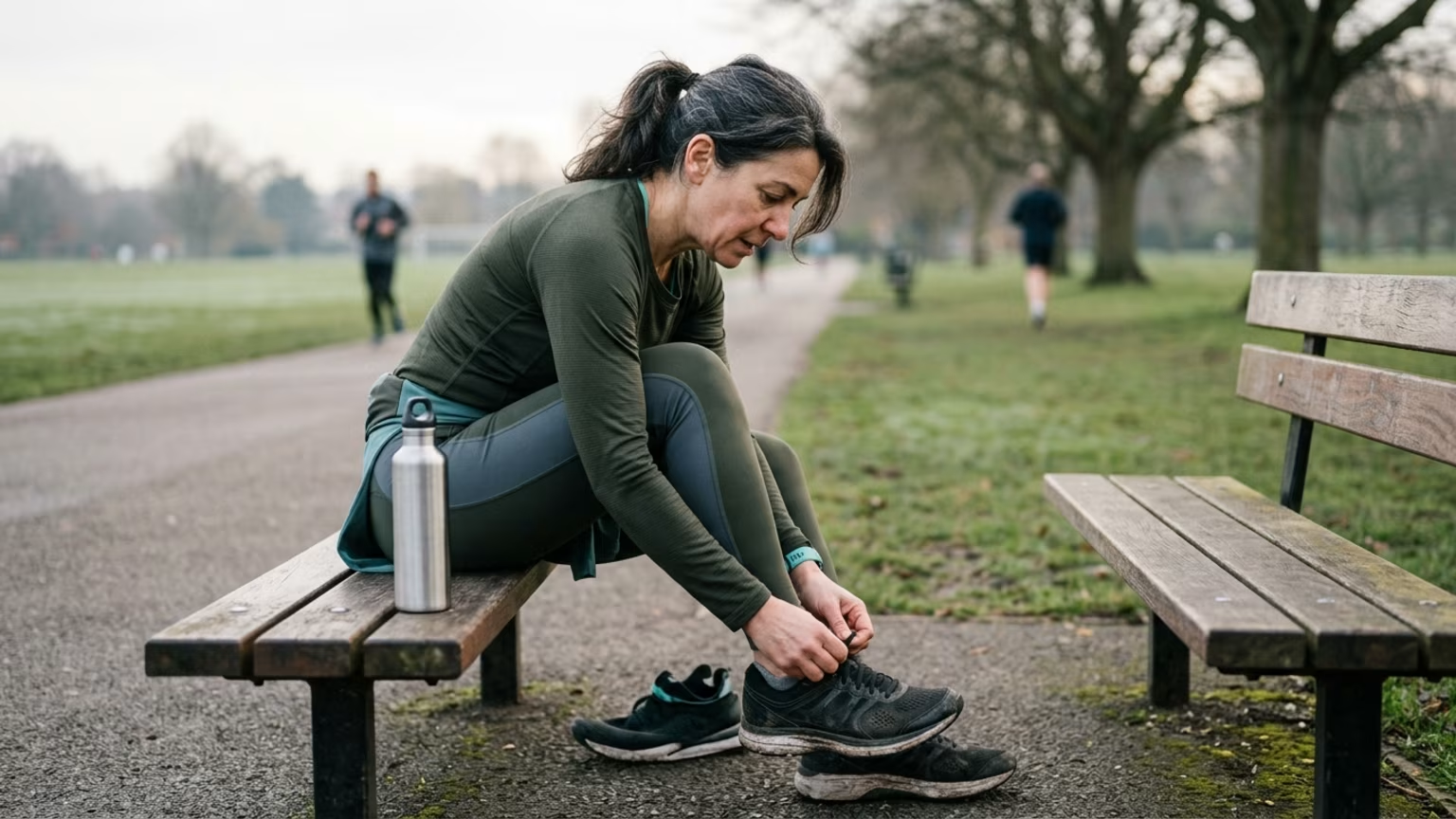

A 2026 McGill study found that a 20-minute workout or a 90-minute nap improved memory after 30 hours of sleep loss. Learn how to apply these short-term strategies.





On August 7, 2026, a McGill University-led study published in the Proceedings of the National Academy of Sciences examined whether a short bout of exercise or a nap could protect memory after prolonged sleep loss.
The laboratory study included 54 healthy young adults who remained awake for 30 consecutive hours under supervision. Researchers wanted to observe how different interventions might help people retain information when adequate rest is unavailable. The participants experienced uninterrupted wakefulness in a highly controlled setting. This environment is more extreme than the fragmented sleep loss many adults experience from stress, caregiving, shift work, or repeated short nights.
Participants were assigned to one of three conditions during the experiment. They either completed 20 minutes of cycling, took a 90-minute nap, or sat through a no-intervention control period. After completing their assigned intervention, the research team asked participants to view a series of images to test their episodic memory. The researchers then formally assessed their memory performance three days later.
The memory assessment occurred three days after participants viewed the images. This timeline makes the result highly relevant to information retention. The outcome was specifically focused on episodic memory for images rather than every single form of general cognition. The study does not establish that exercise or napping improves judgment, reaction time, or emotional regulation. Furthermore, the findings do not guarantee improved complex work performance or driving safety after sleep deprivation.
The results showed a measurable cognitive benefit for both the active and the restful interventions. Both the exercise group and the nap group performed about 22 percent better on memory tests than the control group. The reported 22 percent improvement was an average comparison with the no-intervention control group. It should not be presented as a guaranteed improvement for every sleep-deprived person in every daily situation.
While the memory outcome was similar, the study did not find that exercise and napping worked through the same biological pathway. According to EEG recordings taken during the study, napping appeared to reduce neural fatigue and lower sleep pressure. This period of rest helped make the brain significantly more receptive to new learning.
Exercise offered a distinctly different mechanism for short-term cognitive support. A brief workout appeared to help the sleep-deprived brain process information more efficiently. The physical activity provided this specific benefit without increasing the subjective fatigue reported by the participants. The paper places this research in the context of widespread insufficient sleep and the practical difficulty of applying sleep-hygiene advice when sleep loss is unavoidable.
The study compared a 20-minute cycling intervention with a 90-minute nap. The research does not establish that every form of exercise, every nap length, or every exercise intensity will have the same effect. Readers should avoid assuming that any arbitrary movement routine is directly proven by this specific research. The findings support short-term memory protection, not a cure for chronic sleep deprivation or persistent stress.
A separate 2026 paper in the journal SLEEP added further context to how physical activity might interact with rest. This related study examined acute moderate-intensity exercise during sleep restriction. The researchers reported that the relationship between exercise and declarative-memory performance was statistically mediated by the percentage of slow-wave sleep.
This finding suggests that exercise might influence memory through subsequent sleep architecture rather than immediate alertness alone. However, the SLEEP paper involved a different protocol from the McGill-led study. It should not be interpreted as proof that a short workout can outright replace lost sleep.
The primary study was authored by a research team that included Madhura Lotlikar and Marc Roig. Their paper was titled “Protecting episodic memory after sleep loss: Similar benefits of exercise and naps via distinct neural contributions.” The team framed these findings as highly relevant to fatigue-management strategies in demanding professional environments. They noted that these interventions could support safety-sensitive settings such as health care, mining, transportation, and emergency response.
In these unpredictable environments, obtaining additional sleep is often not immediately practical. Senior author Marc Roig said that even a brief bout of exercise may help preserve memory when people cannot simply stop their activities and sleep.
First author Madhura Lotlikar provided further context on the practicality of these findings for busy professionals. Lotlikar described exercise as accessible, inexpensive, and easy to implement. At the same time, the researcher noted that a nap is not always possible during a typical work shift.
The researchers explicitly stated that exercise cannot completely replace sleep. The study simply examined whether a workout could help people function better when adequate rest was temporarily unavailable. The research team called for further implementation studies before applying the approach in safety-critical occupations.
For adults managing careers and caregiving, losing sleep is often a frustrating reality rather than a laboratory experiment. After an isolated bad night, a short bout of moderate-to-vigorous activity may be a practical option when taking a long nap is impossible. You might use a brief cycling session as short-term damage control after an unusually poor night.
When time and circumstances do allow, a 90-minute nap was associated with a similar memory benefit in this specific study. The choice between resting and moving can be framed around your immediate daily goal. A nap may help restore a more receptive brain state when your schedule permits a long break. Conversely, exercise may help a tired brain process information more efficiently when you must remain awake.
Neither option should become an excuse to ignore recurring sleep problems. The McGill study addressed temporary, experimentally induced sleep loss rather than chronic insomnia or an underlying sleep disorder. The sample consisted of healthy young adults in a highly controlled laboratory setting. Therefore, the results cannot automatically be generalized to adults over 35 experiencing cardiovascular disease, neurological conditions, or significant medical fatigue.
For adults with persistent snoring, witnessed breathing pauses, or ongoing daytime impairment, this evidence is not a substitute for a thorough medical assessment. If you regularly struggle with feeling wired when you want to wind down, a quick workout will not fix a chronic routine issue. You must still prioritize consistent rest over temporary lifestyle patches.
Adults should not routinely compensate for poor sleep with just exercise or naps. Instead, these brief interventions offer temporary support for memory when a bad night cannot immediately be repaired. If you are noticing subtle shifts in your daily energy levels, it helps to evaluate your habits holistically. You can assess your daytime fatigue by monitoring your energy accurately rather than relying on quick fixes alone.
If you find yourself needing a 90-minute nap every afternoon, it might be time to reset your sleep routine entirely. These short-term strategies are tools for resilience rather than long-term replacements for the restorative power of a full night of sleep. Taking a proactive approach means understanding that your body clock shifts after 35, requiring more deliberate and consistent daily habits.
As researchers continue to unpack the distinct neural contributions of movement and rest, how will these insights reshape our long-term approach to midlife recovery and workplace fatigue?
Transitioning from understanding the cognitive benefits of a brief cycling session to actually trusting your personal recovery metrics requires clear, objective information. Relaxopia translates credible evidence into practical guidance for adults navigating uncertainty about sleep trackers, wearables and new recovery technology, helping you establish habits that genuinely restore your daytime energy. Explore Resources
Stay connected for research-led guidance on sleep quality, stress, circadian rhythm, recovery, fatigue and everyday energy. Clear ideas for adults 35+ who want to sleep better, recover more fully and feel more capable through the day.




Explore practical guidance on sleep, stress and recovery without chasing every new hack, device or promise.
explore the blog