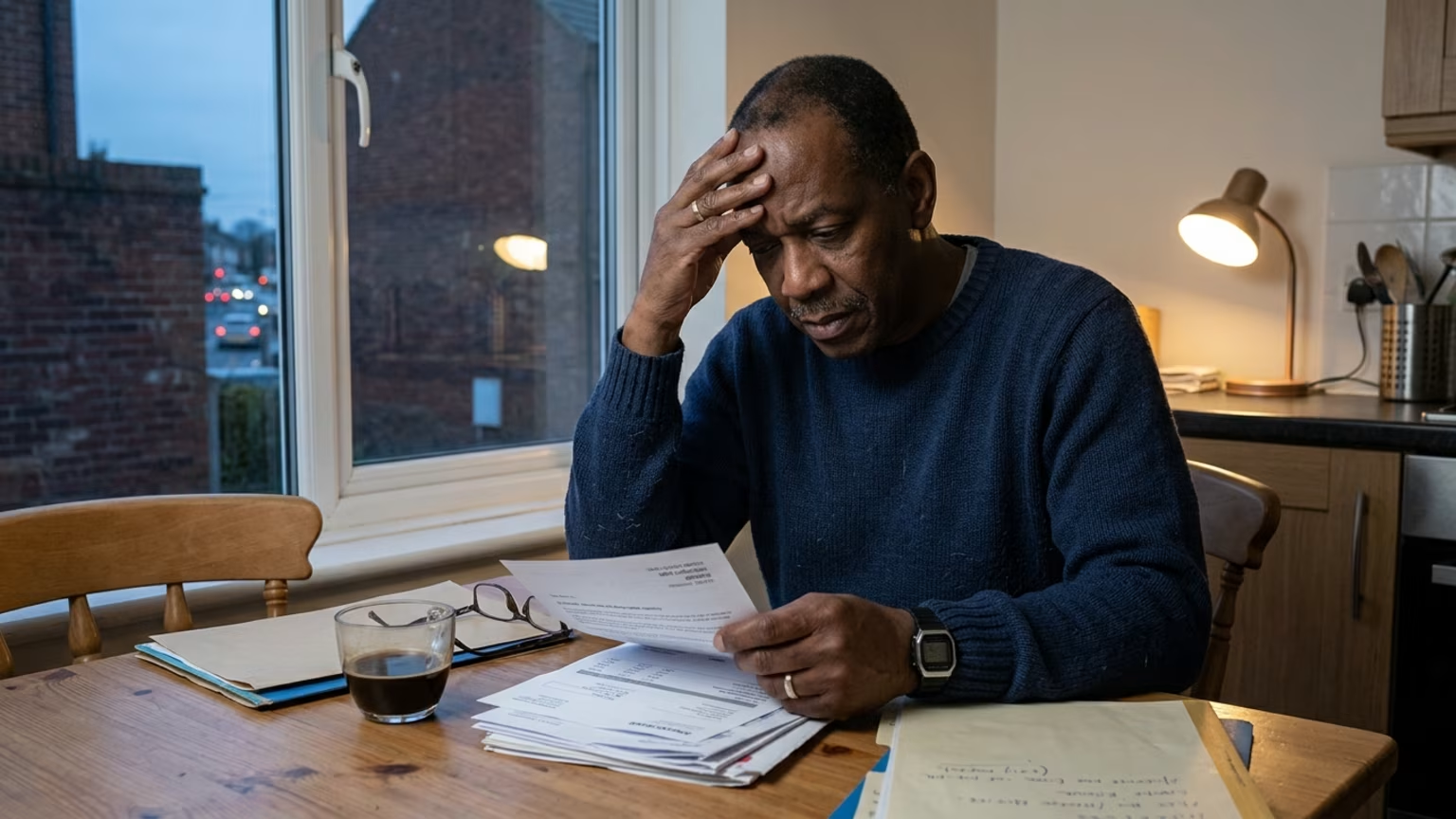

Personal coping habits can regulate your physiological baseline, but they cannot fix structural workplace overload or excessive professional demands.





On September 25, 2026, Forbes published a feature arguing that personal coping tools help regulate stress responses but cannot resolve structural workplace problems. The publication reported that individual habits cannot fix conflicting priorities, excessive demands, or a damaging management culture.
The core finding from the reporting highlights a critical distinction between personal habits and organizational conditions. Practices like breathing exercises, physical movement, and mindfulness serve as valuable tools for individual regulation. However, they are not structural cures for toxic environments. Relying solely on these habits to manage impossible expectations shifts the responsibility for poor work design onto the employee.
To contextualize the widespread nature of daily pressure, Forbes cited a massive global survey. Gallup researchers collected data from more than 141,000 employed adults. These respondents spanned over 140 different countries. The survey found that 40 percent of the global workforce had experienced stress the previous day.
This figure highlights a systemic pattern in modern work environments. The reported data showed significant regional variations across the participating countries. In the United States and Canada, the rate of previous-day stress was notably higher. Half of the respondents in these two nations reported experiencing stress the day prior.
The survey data captures subjective reporting rather than establishing formal clinical diagnoses. Still, reaching 50 percent indicates a profound level of daily activation among North American professionals. Gallup also tracked distinct differences across demographic lines. Women were measurably more likely than men to report stress the previous day.
The data showed 43 percent of female respondents experienced daily strain compared to 39 percent of male respondents. These variations suggest that structural demands do not affect all employees equally. Organizational hierarchy also played a clear role in the reported findings. Managers were more likely to report previous-day stress than those in non-managerial roles.
The survey found that 45 percent of managers experienced strain compared to 39 percent of non-managers. These numbers illustrate the heavy burden of balancing team oversight with upper-level directives. The responsibility of leadership frequently compounds the baseline demands of the workplace.
Prolonged professional pressure creates measurable operational consequences for organizations. Forbes reported on 2025 research conducted by the UK Chartered Institute of Personnel and Development. The institute examined the primary drivers of employee absence across the workforce. They found that over a quarter of employees cited stress among their top three reasons for taking leave.
This finding demonstrates how unmanaged demands eventually disrupt consistent attendance and overall productivity. When workplaces ignore the biological limits of their workforce, systemic overload forces employees to step away entirely. Personal wellness routines cannot sustainably offset the physical toll of a damaging management culture. At a certain point, the body requires actual distance from the source of the strain.
The reporting featured direct warnings from clinical and occupational health experts regarding this dynamic. Simon Smail is identified by Forbes as a general practitioner and occupational health physician. He directly addressed the fundamental limitations of individual wellness tactics in hostile environments. Smail says employees cannot be expected to "breathe [their] way out of an impossible workload or a damaging management culture."
This perspective cautions against utilizing corporate resilience training to excuse poor organizational structure. When a company expects individuals to meditate away the effects of bullying, it completely ignores the root cause. Coping practices are designed to support a healthy baseline. They are not built to indefinitely absorb the impact of conflicting priorities and excessive external demands.
The Forbes article specifically names breathing exercises, physical movement, sleep, and mindfulness as common methods for managing strain. These psychological techniques and physical habits provide genuine utility for daily regulation. They help lower heart rates, clear mental clutter, and reset the nervous system after a difficult meeting. For adults balancing careers and family obligations, these routines establish necessary daily stability.
However, the reporting issues a strong caution regarding how these tools are utilized. Forbes notes that these practices do not fix the structural work conditions driving the stress in the first place. Mindfulness can help you remain calm during a tense conversation, but it will not reduce an impossible quota. Breathing exercises can steady your nerves, but they cannot resolve conflicting priorities assigned by leadership.
This distinction matters deeply for adults who feel they are failing at wellness. When you apply these tools to systemic problems, the tools inevitably appear to fail. This perceived failure can create secondary frustration, making you feel entirely responsible for your exhaustion. Recognizing that coping mechanisms only regulate your internal state frees you from expecting them to solve external structural flaws.
Coach and burnout researcher Jemma Broadstock provided a clear framework for evaluating professional capacity. She frames the central issue as whether people have enough resources and recovery to match the demands placed on them. This perspective aligns with the physiological reality that sustainable human performance requires adequate biological downtime. When demands consistently outpace resources, even the best coping mechanisms will eventually fail.
For adults evaluating their own daily capacity, recognizing this imbalance is crucial. Understanding how daily pressures compound over time helps you separate temporary fatigue from chronic environmental strain. This awareness prevents you from interpreting a normal biological limit as a personal failure in resilience. A persistently challenging environment requires structural boundary setting rather than just stricter personal habits.
Clinical psychotherapist Gareth Strangemore-Jones provided perspective on the functional nature of biological reactions. He distinguishes short-lived, proportionate arousal from ongoing and relentless stress. Strangemore-Jones says a brief surge can actually energize people and sharpen their attention. This beneficial physiological response occurs when the objective is clear and the demand is limited in time.
This acute mobilization also requires the individual to believe they possess sufficient resources to meet the challenge. The psychotherapist recommends reconsidering how we interpret sudden physical signs of strain. A faster heartbeat or a sense of heightened alertness is not necessarily proof that someone cannot cope. Strangemore-Jones suggests this physical arousal may simply reflect the body mobilizing resources for an important task.
Forbes notes that viewing arousal as potentially useful can produce a small improvement in performance. Recognizing the difference between a natural surge and chronic activation reduces unnecessary worry about your own physiological responses. The goal is not to eliminate all pressure from your professional life. Instead, you want to make sure that acute challenges do not become persistent baseline states.
For midlife professionals, the practical implication involves calibrating your expectations for daily recovery routines. You can use sleep, movement, and mindfulness to support your physiological regulation. The Centers for Disease Control and Prevention notes that most adults need at least seven hours of sleep each night. You should treat this biological rest as foundational support rather than a cure for a hostile workplace.
If persistent pressure leaves you exhausted, your habits might be functioning perfectly while the external demands remain objectively too high. Establishing a reliable baseline often requires focusing heavily on predictable physical rest. Prioritizing a structured transition away from the workday helps protect your evening recovery window. These transition practices create necessary distance between professional obligations and personal restoration.
Another practical application involves adjusting your psychological approach to difficult work environments. Strangemore-Jones offers a specific definition of acceptance for navigating unchangeable circumstances. He says acceptance means acknowledging what is presently true and directing energy toward what remains influenceable. He explicitly distinguishes that structured approach from approval, resignation, or pretending that a situation is acceptable.
This specific form of acceptance allows you to allocate your mental resources effectively. You can recognize a heavy workload without endorsing the management decisions that created it. By acknowledging the reality, you can focus on protecting your downtime or setting firmer communication boundaries. This pragmatic mindset helps you navigate unavoidable pressure without surrendering your personal autonomy.
Developing this measured approach takes time and consistent daily application. You can build your capacity by identifying which factors are genuinely within your control. Implementing a framework to map your specific daily triggers clarifies exactly where to direct your limited energy. This strategy transforms acceptance from a passive state into an active management tool.
As research continues to differentiate between temporary physiological mobilization and prolonged environmental strain, the conversation around workplace pressure is shifting. We must stop viewing resilience as merely an individual tolerance for poor structural design. How will organizations and individuals collaborate to build environments that balance performance demands with the fundamental biological need for recovery?
Recognizing the structural limits of individual stress management helps adults establish realistic expectations for their daily habits, and Relaxopia translates the relevant clinical research to guide that process. Navigating excessive workplace demands often amplifies uncertainty about sleep trackers, wearables and new recovery technology, but we evaluate the foundational evidence to help you identify which practices actually support your baseline rest.
Stay connected for research-led guidance on sleep quality, stress, circadian rhythm, recovery, fatigue and everyday energy. Clear ideas for adults 35+ who want to sleep better, recover more fully and feel more capable through the day.






Explore practical guidance on sleep, stress and recovery without chasing every new hack, device or promise.
explore the blog