

Welltory data shows how tracking rest can worsen sleep anxiety. Learn why viewing multi-day trends and avoiding nighttime app checks improves adult recovery.





On September 30, 2026, health technology platform Welltory published an observational report detailing how sleep anxiety affects nighttime rest. The article, which the company updated on October 6, 2026, examines how focusing too intensely on sleep trackers can sometimes worsen overall sleep quality. Welltory founder Jane Smorodnikova and deputy COO Tatsiana Yashyna authored the findings, utilizing data drawn directly from their own user base. They analyzed the tension between monitoring rest and the worry that monitoring can provoke.
For adults over 35, changes in rest are a normal part of life. Demanding careers, caregiving responsibilities, and everyday stress often lead to less consistent recovery. Many people turn to wearable devices to track these changes, hoping that daily metrics will reveal a clear path to better energy. Tracking your habits can be an insightful way to view how daily strain impacts your body.
Measuring a natural biological process can sometimes transform it into a stressful performance metric. When resting becomes another task to manage, the pressure to sleep well can actively prevent you from winding down. Seeking reassurance from a screen often backfires when the numbers do not match your expectations.
This specific type of worry differs from general daily stress. The Welltory article distinguishes between the normal worries that surface at bedtime and a distinct worry specifically about sleep itself. For example, a person might lie awake fearing that they will not be able to fall asleep at all. They might worry about being completely unable to function the next day.
This fear creates a state of physical arousal. While sleep anxiety is not a formal diagnosis on its own, it is a recognized barrier to consistent recovery.
The primary conclusion from the Welltory report is that hyper-focusing on sleep tracking can function like an older, well-known sleep obstacle: clock-watching. When people obsess over their nightly scores, they may experience increased anxiety about their sleep quality. This heightened focus can make it significantly harder to fall asleep or return to sleep after waking up in the middle of the night.
To investigate this cycle, Welltory analyzed 292,407 pairs of consecutive nights tracked by 3,555 selected users. The company collected this observational data from December 2025 through March 2026. For inclusion in this analysis, users had to have at least 30 tracked nights and a minimum of three recorded rough nights.
The company defined a rough night internally as having at least 40 minutes awake in bed or getting less than five hours of total sleep. Welltory notes that this is an analytical threshold for their software, not a clinical definition of insomnia.
The analysis showed that 26.2% of nights met this rough definition for a typical user in their sample. This figure provides helpful perspective for adults experiencing inconsistent energy. It shows that poor rest is a frequent occurrence among users who track their health.
The data offers a reassuring look at what happens next. The report states that after one rough night, 72.3% of the subsequent nights were not rough. Only 27.7% of the nights following a bad night met the rough criteria again.
When bad nights accumulate, the pattern frequently breaks on its own. The company reported that after two consecutive rough nights, the likelihood of a third rough night was 32.9%. The odds still favor a return to better rest. A poor score on a Tuesday does not mean your Wednesday is destined to fail.
Welltory cautions that its analysis is observational and involves a non-random user base. The results describe their specific users and should not be treated as a population-wide guarantee. Illness, extended travel, or prolonged stress can certainly produce longer streaks of poor rest.
The article contextualizes these analytical findings within established sleep psychology. Discussing the impact of checking tracker data during the night, the Welltory authors characterize nighttime app-checking as "clock-watching with extra steps." This modern habit mirrors a well-documented issue in behavioral sleep medicine, where monitoring the time creates a sense of urgency.
The Welltory report draws heavily on Allison Harvey’s 2002 cognitive model of insomnia. This psychological model explains how worry about sleep, combined with a fear of daytime consequences, can contribute to physical arousal. When you lie awake worrying about tomorrow's exhaustion, your nervous system remains alert. This physical distress makes falling asleep even more elusive, creating a frustrating loop of wakefulness.
To illustrate this mechanism, the Welltory article describes clock-monitoring experiments published in 2007. In one of those experiments, researchers observed 30 good sleepers and 30 poor sleepers. The findings showed that clock-watchers reported more pre-sleep worry and took noticeably longer to fall asleep. A second experiment conducted that same year involved 38 people with insomnia, further reinforcing the negative impact of monitoring time.
Modern technology has simply moved the clock from the nightstand to the wrist. The article cites a 2017 paper by Baron and colleagues that named this modern phenomenon orthosomnia. The researchers defined orthosomnia as a perfectionistic pursuit of ideal sleep data. The Welltory page notes that for some users, concerns about their recovery are driven entirely by tracker readings rather than how they actually feel.
The 2017 paper did not conclude that all tracking is inherently harmful. The Welltory article clarifies that the researchers did not recommend abandoning trackers entirely. They argued for incorporating tracker use into structured treatments, like cognitive behavioral therapy for insomnia. Reviewing the intersection of sleep environment, habits, and technology shows that the tool itself is neutral, but the user's relationship to the data determines the outcome.
For adults working to improve their nighttime routines, the practical takeaway is to change how and when you interact with your sleep data. Tracking should support your well-being rather than serving as a nightly performance test. The Welltory article outlines several practical recommendations for users who find their devices are causing stress.
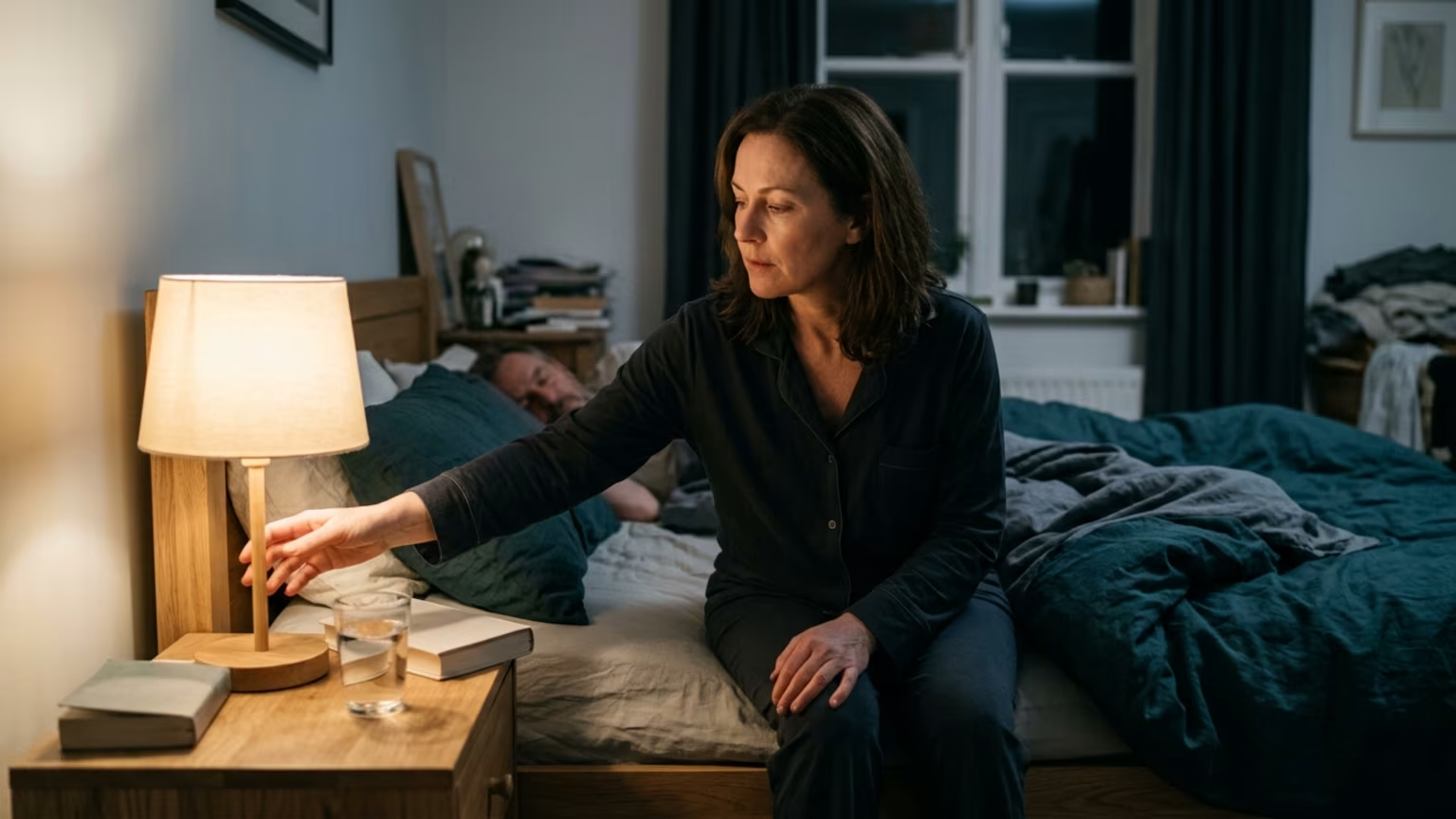
One step is to avoid checking your app during the night. If a score typically prompts worry, opening your tracker during a middle-of-the-night awakening is counterproductive. The researchers advise keeping the device out of sight until the morning. Checking how an overloaded mind keeps you awake shows that mental off-ramps are crucial for rest.
Adding a data review to your nighttime waking only stimulates your brain further.
Another adjustment involves reviewing your multi-day trends instead of obsessing over a single night. Give greater weight to how you feel and function over time. The Welltory article recommends looking at patterns across roughly one to two weeks. Treating one night as a definitive verdict on your health creates unnecessary pressure.
A broader view helps you recognize that occasional poor rest is a normal variation. You can learn more about better sleep and sleep quality to build a sustainable perspective on recovery.
Treating sleep stages as broad estimates rather than precise medical measurements is also critical. Wearable devices infer sleep by monitoring signals like your physical movement and your heart rate. They are much better at distinguishing sleep from wakefulness than they are at identifying exact sleep stages. Treat labels such as deep sleep or REM sleep as approximations.
The Welltory authors point out that their product is a general wellness tool. It is not a sleep study, and consumer estimates cannot diagnose a sleep disorder.
Taking a temporary pause is a helpful option if tracking itself is making you more anxious. You do not have to abandon your device forever, but taking a break can help you reset. It is often more productive to pause your tracking than to try harder to achieve a better score.
Building a realistic sleep routine without the clock helps signal to the body that the workday is over. If you experience persistent sleep difficulties, remember that a tracker is not a substitute for medical care or cognitive behavioral therapy.
Will future sleep technology focus more on calming our nighttime anxieties rather than simply scoring our deficits? As we learn how hyper-focusing on daily data can interfere with our rest, the next generation of recovery tools may need to reconsider how they present information. The challenge for future devices will be providing useful insights without turning the natural process of sleep into a stressful, high-stakes metric.
Deciding how to interpret sleep tracker data without letting an app dictate your daily mood requires clear, objective boundaries. Relaxopia translates credible evidence into practical guidance for adults 35+ dealing with low daytime energy and inconsistent recovery. We help you look past the nightly scores to build manageable resting habits that genuinely support your life, separating verified science from the pressure of wellness optimization.
Stay connected for research-led guidance on sleep quality, stress, circadian rhythm, recovery, fatigue and everyday energy. Clear ideas for adults 35+ who want to sleep better, recover more fully and feel more capable through the day.




Explore practical guidance on sleep, stress and recovery without chasing every new hack, device or promise.
explore the blog