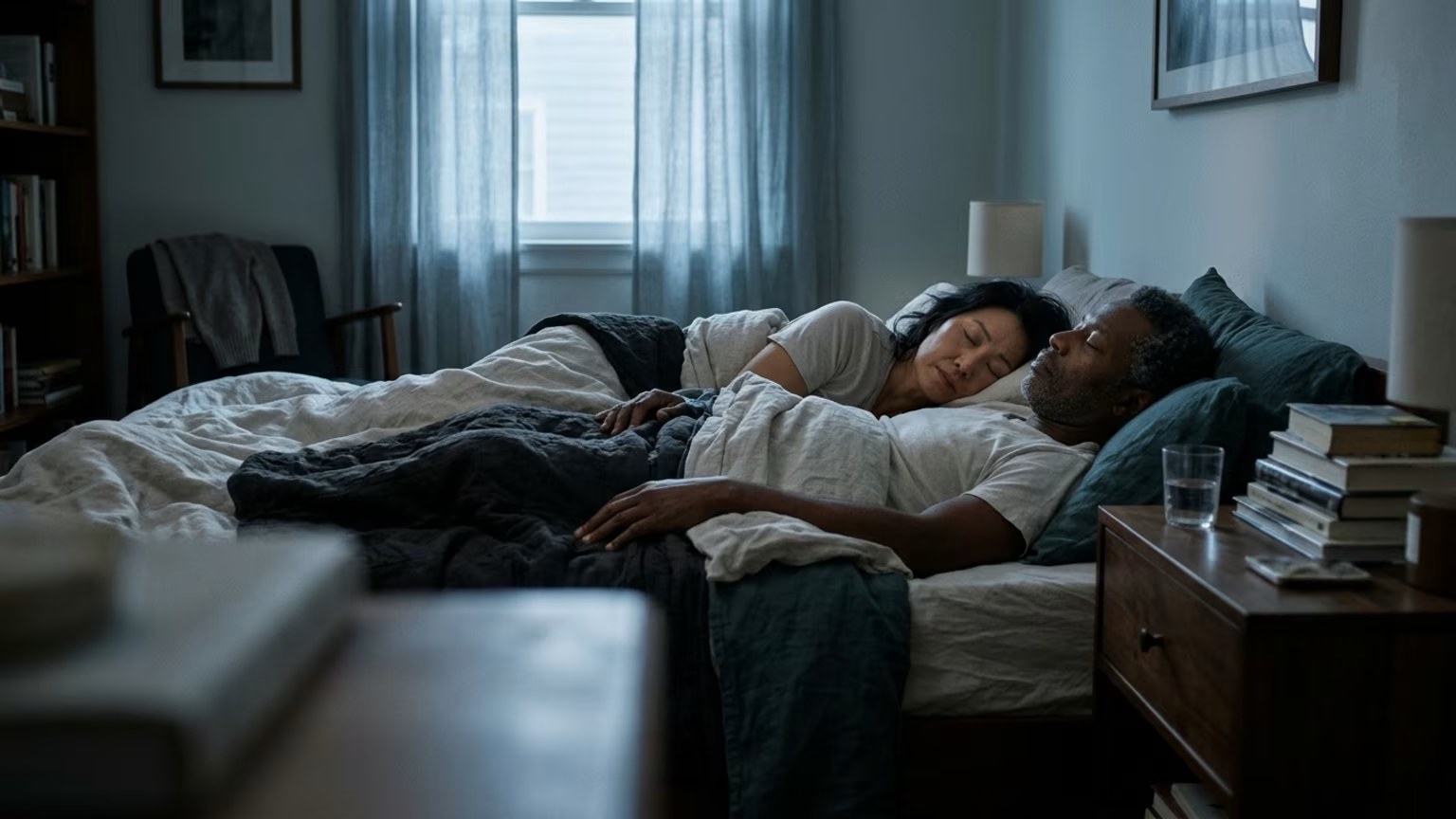

A small couples study found more stable REM sleep during bed-sharing. Learn how to weigh that finding against tiredness and nighttime disruption.





On 2026-10-29, Yahoo Health published a look back at a 2020 sleep-laboratory study that found a modestly higher proportion of REM sleep when couples shared a bed. Researchers monitored 12 young, healthy couples while they slept together and separately.
According to Yahoo Health’s report, participants averaged 23.0% of total sleep time in REM sleep when sharing a bed, compared with 21.0% when sleeping alone. That is a 2-percentage-point difference in the share of sleep spent in that stage.
The report also described changes in how continuous REM sleep was during the shared-bed condition:
In plain English, the shared-bed nights included a little more REM sleep and longer stretches of REM without interruption. These are the measurements behind the description of “more stable” REM sleep.
Researchers used simultaneous polysomnography to record both partners’ sleep. Yahoo Health describes this method as capturing signals that include brain waves and movement. It also records breathing and other physical activity during sleep.
The distinction between REM proportion and REM continuity matters when reading the headline. The percentage describes how much of the recorded sleep belonged to that stage. The interruption count and uninterrupted periods describe how that stage was distributed across the night.
Yahoo Health also reported greater sleep-stage synchronization when partners shared a bed. At zero time lag, partners were in the same sleep stage for 46.9% of the night when sleeping together, compared with 36.6% when sleeping separately.
“Zero time lag” means the comparison looked at what both partners were doing at the same moment. If their recorded sleep stages matched then, that counted toward synchronization.
This is a different observation from the REM finding. The REM results describe the amount and continuity of a particular sleep stage. Synchronization describes how closely the timing of one partner’s stages matched the other’s.
Keeping those findings separate makes the report easier to interpret. A couple could be interested in uninterrupted sleep while researchers are examining stage timing. Both concern sleep, but they answer different questions.
The study’s limits belong alongside its results. The 24 participants were young, healthy adults in heterosexual couples who already habitually shared a bed. That narrow sample does not settle the best arrangement for adults 35+ or couples managing health conditions and persistent nighttime disruption.
These were group averages recorded under laboratory conditions. They do not predict a fixed REM gain for an individual couple at home. The research also did not test a personalized tool for choosing whether to sleep together or separately.
More synchronized sleep stages do not establish that both people slept better or felt more restored. The available reporting does not establish improvements in next-day alertness or wider health. It also does not demonstrate reduced stress or stronger relationships.
A secondary account of the study published in 2026 also notes increased leg movements during shared sleep. The overall picture is therefore a set of sleep measurements with possible trade-offs, rather than a single verdict in favor of bed-sharing.
For an adult between 35 and 65, the practical adjustment is to bring each partner’s actual sleep experience into the conversation. A brief morning check-in can focus on whether either person was repeatedly awakened and whether sleep felt restorative. Daytime tiredness belongs in that discussion too.
The useful question is not whether a shared bed wins a research comparison. It is whether the current arrangement is working for both people. That keeps the discussion close to the concerns the research leaves open.
Ask how each partner slept before trying to agree on one description of the night. One person may report uninterrupted rest while the other describes repeated waking. Both accounts deserve space in the decision.
Useful questions include:
These questions follow the practical issues raised in the reporting. They keep attention on the experience of sleep rather than turning the study’s REM percentages into a target.
Name the issue as specifically as possible: snoring, movement or schedules that do not fit comfortably together. The purpose is to identify what needs attention rather than decide who is responsible for a bad night.
A conversation about weighing both partners’ sleep needs can stay separate from judgments about closeness. A sleeping arrangement is a practical choice. It need not become a statement about how committed either person is to the relationship.
The study gives couples a reason not to assume that sharing a bed is inherently harmful to sleep. It does not make bed-sharing an obligation. Repeated disruption still deserves attention when one partner feels comfortable with the arrangement and the other does not.
That leaves room for shared or separate sleeping arrangements according to both partners’ needs. The aim is a workable choice, not a rule that every couple must follow.
For midlife readers, the most relevant concern may be feeling tired after allowing enough time for sleep. In the context of this study, that makes a partner’s report of repeated waking more useful than an abstract preference for higher REM percentages.
A practical conversation can distinguish time spent in bed from how the night felt. “We were in bed long enough” and “I kept waking up” describe different parts of the experience. Neither person needs to dismiss the other’s account to discuss what happened.
Relaxopia’s coverage of looking beyond total sleep hours offers a related reading path for that discussion. Here, the starting point remains straightforward: pay attention to repeated interruptions and persistent daytime tiredness.
Keep the observation specific enough to be useful. Rather than deciding that shared sleep is good or bad in principle, describe what is happening for each sleeper. That information can support a practical discussion about arrangements or a conversation with a healthcare professional.
The American Heart Association lists the following among possible signs of obstructive sleep apnea:
These signs are not a diagnosis. They are reasons to discuss the situation with a healthcare professional, particularly when snoring comes with breathing pauses or notable daytime sleepiness.
This is a separate decision from whether to share a bed. Changing rooms may change what a partner hears or experiences. It would not establish or address a possible sleep disorder.
Keeping those questions separate prevents the sleeping-arrangement discussion from carrying more responsibility than it should. Couples can talk about nighttime disruption while also seeking qualified care for symptoms that deserve assessment. A comfortable arrangement and attention to possible breathing problems are not competing priorities.
The next useful research question is broader than whether partners’ sleep stages match. For midlife adults, it would be valuable to connect laboratory measurements with how people feel and function after sleep at home.
Future studies could examine a wider range of couples and the disruptions that shape their nights. They could also assess whether differences in REM continuity accompany meaningful changes in next-day tiredness. Those outcomes would bring the evidence closer to the decisions adults make when rest no longer feels reliably restorative.
For now, the finding supports an open conversation rather than a universal sleeping rule. Could future research help midlife couples choose arrangements that support both partners’ long-term recovery, rather than judging success by REM percentages alone?
Deciding whether to keep sharing a bed starts with each sleeper’s experience; Relaxopia adds research-led explanation to help readers interpret the evidence behind that choice. For adults 35+ who allow enough time for sleep yet still feel tired, its coverage connects sleep quality with fatigue and recovery without prescribing a rigid routine.
Stay connected for research-led guidance on sleep quality, stress, circadian rhythm, recovery, fatigue and everyday energy. Clear ideas for adults 35+ who want to sleep better, recover more fully and feel more capable through the day.




Explore practical guidance on sleep, stress and recovery without chasing every new hack, device or promise.
explore the blog