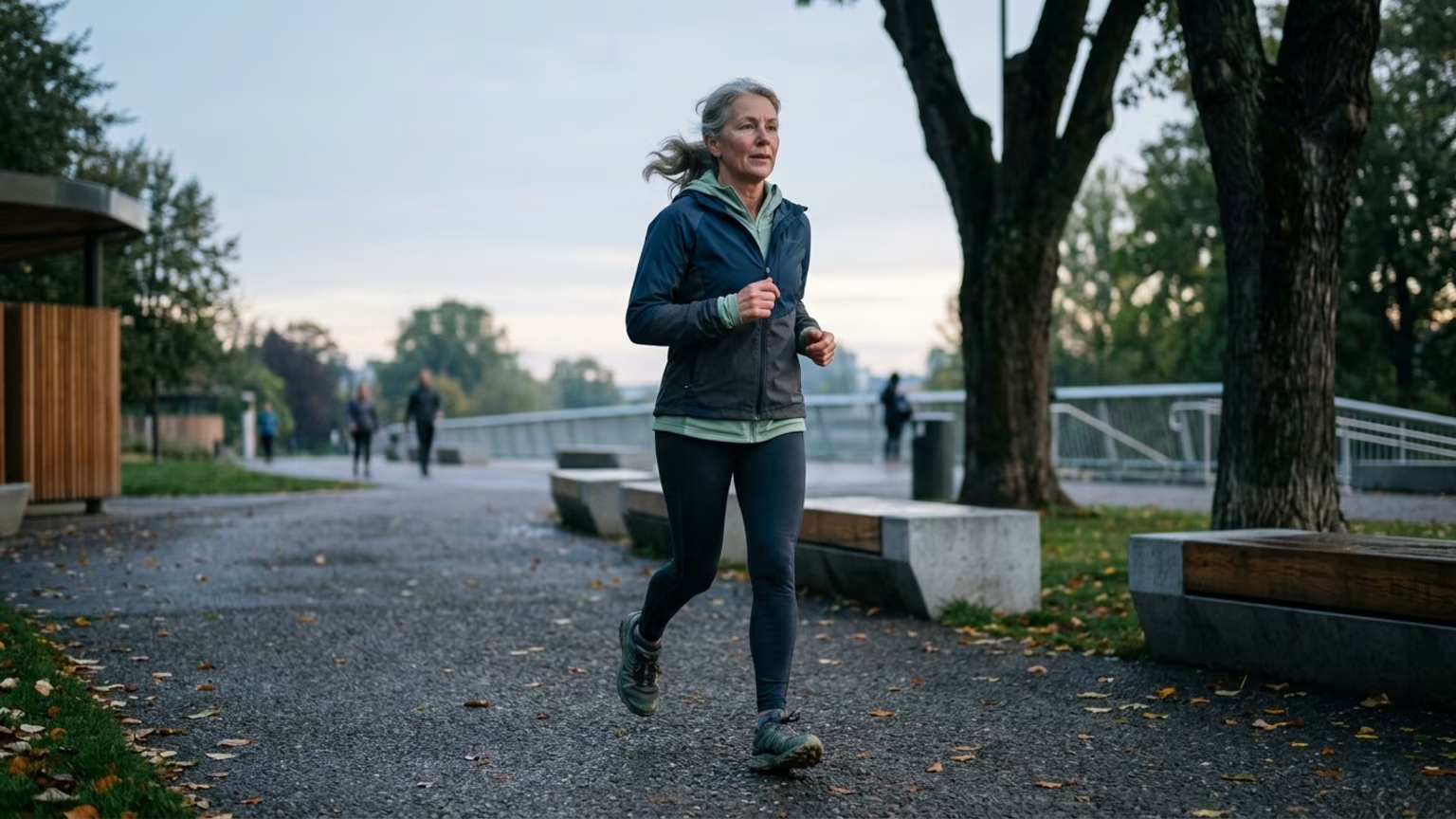

A recent Forbes report reviews how exercise may affect cortisol and rumination before stressful tasks. Learn how adults over 35 can apply these findings.





A Forbes report published on September 22, 2026, examines how physical activity might interrupt rumination and alter biological stress responses. The coverage evaluates whether strategic exercise could help leaders maintain performance during periods of pressure and sleep deprivation.
Explaining the physiological connection between physical exertion and mental stress requires careful attention to clinical data. The Forbes article discusses exercise as a possible method to interrupt rumination or alter the body’s response to a later psychological stressor. The publication explicitly notes that current evidence does not establish that exercise replaces sleep. It also does not guarantee better leadership performance in real-world professional environments. The underlying studies provide specific laboratory observations rather than universal solutions for workplace fatigue.
One of the central pieces of evidence involves a 2021 study published in Psychoneuroendocrinology. Researchers assigned 83 healthy young men to 30 minutes of light, moderate, or vigorous treadmill exercise. Forty-five minutes after completing their assigned physical activity, the participants faced a standardized laboratory stressor. This challenge required them to complete public-speaking tasks and mental-arithmetic problems in front of a panel of evaluators.
The results highlighted distinct differences based entirely on the intensity of the prior exercise. The vigorous-exercise group demonstrated a noticeably slower cortisol increase during the subsequent stress task. They were compared directly against the participants in the light-exercise and moderate-exercise groups. The men who exercised vigorously showed a lower overall cortisol peak during the mental challenge. They also experienced a faster return toward their baseline cortisol levels once the stress task ended.
Crucially, the vigorous exercise initially produced the largest cortisol response. This physiological spike occurred immediately after the treadmill session and before the mental tasks even began. The authors of the study proposed a specific biological explanation for this interesting pattern. They suggested that the large initial exercise-induced response may have activated negative feedback mechanisms in the body. This biological feedback loop could have constrained the later cortisol response to the psychological stressor.
While this theory sounds logical, the Forbes report clarifies a critical limitation of the research. The study was not designed to prove this specific negative-feedback mechanism. The exact biological pathway remains a proposed theory rather than a verified clinical fact. The data confirms the physiological result of lowered cortisol during the stress task. It does not definitively prove the underlying cause of that biological blunting effect.
The physical response to stress is only one part of the recovery equation for working adults. Mental repetition and intrusive thoughts often compound the initial anxiety of a difficult workplace event. The Forbes article reviewed another specific study involving 24 adults diagnosed with moderate or severe depression. Researchers intentionally induced rumination in the participants before separating them into two different recovery protocols. This design allowed them to observe how different interventions affected ongoing negative thought loops.
The participants completed separate sessions consisting of 30 minutes of moderate cycling and 30 minutes of seated rest. During the cycling sessions, self-reported rumination began declining after about 10 minutes of exercise. This observation suggests that a relatively brief period of physical engagement might help shift mental focus away from stressors. A smaller EEG analysis conducted within this same rumination study involved only 10 participants. This extremely limited sample size restricts how broadly those brain-activity observations can be applied to the general public.
Another study from 2015 provides additional context regarding how environment might influence our mental loops. Researchers assigned 38 healthy adults to walk for 90 minutes in either a natural or an urban environment. The nature-walk group showed reduced self-reported rumination following their extended walk outdoors. They also exhibited reduced blood flow in a specific brain region strongly associated with rumination. This indicates that the setting of the activity might play a role alongside the movement itself.
For adults managing demanding careers, anticipated pressure often carries over into later meetings or critical decisions. Forbes frames physical activity as a potential reset between demanding situations. The coverage suggests that altering the physiological stress response could theoretically provide a buffer against ongoing pressure. Former Disney CEO Bob Iger is quoted in the Forbes article discussing his own routine. He credits exercise with giving him clarity to "attack the world and day a little more organized."
This statement remains a personal attribution rather than formal study evidence. Relying on exercise to reset the mind requires understanding the strict limits of the available clinical data. The research described in the recent coverage measured laboratory markers and self-reported outcomes. It did not directly measure leaders' objective job performance or long-term career resilience.
The distinction between physical activity and true recovery rest is crucial for adults over 35. The available studies do not demonstrate that exercise can compensate for chronic or acute sleep loss. The Forbes article suggests that exercise might help during sleep deprivation. This suggestion is not a direct finding from the rumination or cortisol studies detailed in the report. Public health guidance continues to treat physical activity and sleep as entirely distinct habits.
The CDC gives separate weekly activity targets and a separate nightly sleep recommendation. Most adults need at least seven hours of sleep each night according to the CDC guidelines. Physical activity should always be discussed as complementary to recovery. It is never a substitute for the fundamental biological restoration provided by sleep. Treating an intense workout as a replacement for lost rest can backfire and increase systemic fatigue.
Translating these laboratory findings into daily adjustments requires a highly realistic approach for adults 35 and older. The cortisol experiment exclusively studied healthy young men facing a standardized, artificial stress task. It does not provide a universal prescription for older adults facing chronic, unpredictable workplace stress. The findings absolutely do not justify pushing into vigorous exercise right before a high-pressure event. The results simply do not establish that harder exercise improves work performance for every person.
A manageable bout of moderate activity could be considered as one option for shifting attention. You can use it strategically after a stressful period to create a defined mental break. The finding that rumination dropped after 10 minutes of cycling offers a useful and highly accessible benchmark. You do not necessarily need an exhaustive workout to interrupt a cycle of negative, repetitive thoughts. A short session of moderate movement might provide the separation needed to transition smoothly between demanding professional tasks.
Aligning your daily habits with established public health guidance provides the safest path to resilience. The CDC recommends at least 150 minutes of moderate-intensity activity per week for most adults. Individuals can also aim for 75 minutes of vigorous-intensity activity weekly to meet the official guidelines. Maintaining this consistent baseline is far more effective than using exercise as a sporadic rescue strategy. Understanding how your biological clock functions can help you time these activities effectively.
We know that everyday pressure takes a cumulative, noticeable toll on your physical readiness over time. Addressing chronic stress load involves building multiple supportive habits rather than relying on isolated interventions. Combining sufficient nightly sleep with consistent moderate activity creates a strong foundation for biological resilience. If your sleep is consistently poor, focus heavily on improving your rest opportunities first. Do not use rigorous, high-intensity workouts to artificially push through deep fatigue.
When facing an intense schedule, careful energy management becomes critical for maintaining focus and health. Processing pressure effectively requires emotional regulation alongside supportive, sustainable physical habits. If you feel overwhelmed, a simple change of environment might offer a temporary, helpful mental reset. The 2015 nature-walk study highlights how our immediate surroundings can influence our internal thought patterns. Moving to a different space can help break the tension of a demanding afternoon.
Keep in mind that the nature-walk study involved healthy adults on a full 90-minute walk. It does not establish that a short walk in every setting will produce the exact same effect. Stepping away from your workspace introduces a clear physical break in your daily tension. The goal is to consistently support your body rather than constantly testing its limits. Exercise stress and recovery must be carefully balanced to avoid compounding your daily fatigue.
The ongoing research into physical activity and cortisol raises valuable considerations for long-term workplace health. We are beginning to see a more detailed picture of how physical exertion interacts with mental demands. As studies continue to isolate specific biological mechanisms, will future guidelines offer personalized activity protocols for emotional recovery in midlife?
Confusion about circadian rhythm, light exposure and sleep timing often leads adults to mistime their daily activity and compromise their rest. By translating credible evidence into clear guidance, Relaxopia evaluates this exact clinical data to help you support your long-term energy. Explore Resources
Stay connected for research-led guidance on sleep quality, stress, circadian rhythm, recovery, fatigue and everyday energy. Clear ideas for adults 35+ who want to sleep better, recover more fully and feel more capable through the day.






Explore practical guidance on sleep, stress and recovery without chasing every new hack, device or promise.
explore the blog