
BBC Future reports that ambient temperature may act as a cue for sleep timing alongside light. We explain what this limited evidence means for midlife recovery.





On October 8, 2026, BBC Future published a detailed report examining whether ambient temperature acts as a cue for sleep timing alongside light. The publication investigated emerging scientific evidence about evening cooling and morning warming.
Light has traditionally served as the primary environmental cue for human circadian rhythms. Most sleep science focuses on morning sunlight and evening darkness to anchor the body clock. Researchers are now asking if room temperature provides a secondary input for our internal timing systems. The central question is whether the daily rise and fall of temperature actively guides rest.
This inquiry builds on basic human physiology and our daily interactions with the physical environment. Sleep timing relies on complex biological signals that tell the brain when to begin winding down for the night. Light exposure provides the strongest and most recognized signal for these internal systems. The new analysis investigates whether physical cooling adds another layer of biological instruction.
The BBC report presents this idea as an emerging and unsettled area of study. A natural physiological temperature drop does not by itself establish that external room temperature sets human sleep timing. Understanding how circadian rhythm and sleep timing function helps separate internal body processes from external room conditions.
Understanding the physical relationship between body heat and rest requires looking at a familiar biological process. BBC Future says core body temperature usually declines by about 1°C from its daytime high to its nighttime low. This internal cooling process happens naturally every single evening as the body prepares for sleep.
University of Oxford circadian neuroscientist Russell Foster explains the direction of this relationship. Foster says the circadian rhythm is the primary driver of the pre-sleep fall in body temperature. He maintains that the possible role of external temperature as an incoming signal to sleep systems remains unknown.
Some of the most interesting data comes from populations living without artificial climate control. Researchers studying the Tsimane in Bolivia observed sleep timing that appeared to track ambient temperature changes. The research team also observed similar patterns among the Hadza and San populations. These groups demonstrated sleep timing that tracked the rise and fall of environmental heat rather than simply matching light and dark cycles.
Anthropologist Gandhi Yetish notes that temperature changes naturally along with sunrise and sunset. He acknowledges that the sleep patterns observed in the groups he studied might have resulted from processes other than circadian rhythms. Social activities or physical routines could also influence when these groups choose to sleep. The BBC report does not provide sample sizes for these specific observational studies.
A few controlled studies have attempted to measure how external heat affects biological clocks. In an experiment from 2007 described by the BBC, researchers tested a fluctuating temperature schedule. The room temperature in one condition fell from 27°C to 24°C between 18:00 and 22:00. The temperature then rose back to 27°C from 03:00 to 07:00.
The comparison condition stayed at a constant 27°C throughout the entire night. Participants in the fluctuating-temperature condition had higher overnight levels of a melatonin marker. The BBC reports that these same individuals also reported feeling more refreshed upon waking. The 2007 study reportedly found a measurable shift in internal cooling timelines.
Participants’ core-temperature low point occurred about an hour earlier on average under the fluctuating-temperature condition. The BBC presents this finding as suggestive of a possible effect on circadian timing. It does not serve as absolute proof that temperature fully resets the human body clock.
The BBC also describes a 1974 study concerning human sleep and wake cycles. Participants in this older experiment kept their rooms about 6°C cooler while asleep than while awake. This specific temperature change lengthened their sleep and wake cycles by around 23 minutes. The published report does not supply the study’s title or outline its detailed testing methods.
Animal and cell studies have frequently found temperature-related effects on circadian rhythms. The BBC explicitly cautions that those findings do not necessarily apply to real-life human sleep. Moving from controlled animal biology to practical human bedroom environments requires more extensive testing. This leaves several important questions unanswered for scientists studying human rest.
Experts quoted by the BBC differ on how heavily to weigh these external environmental signals. UCLA neuroscientist Jerome Siegel argues that temperature might be more important than light. Siegel suggests that constant indoor temperatures could matter significantly for daily sleep habits. The report clearly presents this perspective as his specific view rather than an established causal finding.
Chronobiologist Christian Cajochen offers a measured interpretation of the available evidence. Cajochen says that temperature might modulate circadian rhythms, but he points out a lack of concrete data. He notes that very few experiments have actually examined the question directly. Cajochen explicitly cautions readers that “temperature is not the ‘new light’.”
It helps to distinguish possible circadian effects from other ways ambient temperature influences rest. A warm room could easily interfere with the body’s physical ability to relax. This interference can happen without necessarily shifting the actual circadian clock. Sleep physician and scientist Sebastian Herberger says a room that is not cool enough can contribute to shorter and more disturbed sleep.
Researchers have proposed that temperature fluctuations around dusk and dawn could be relevant. The BBC clarifies that the ideal temperature drop for helping people fall asleep is not yet known. Sleep timing and overall sleep quality are not interchangeable outcomes in human studies. Melatonin-related measures and the timing of a core-temperature minimum also represent distinct biological measurements.
The reported findings suggest possible links among them, but they do not establish a single biological mechanism.
Scientific consensus requires repeated testing across diverse groups over extended periods of time. The BBC characterizes the current human evidence regarding temperature and sleep clocks as limited. The publication highlights small studies to support the emerging biological theory. The report states that few experiments have thoroughly tested temperature as an active circadian signal.
The omission of study sample sizes in the published account makes it difficult to judge the absolute scale of the findings. For adults researching the ideal bedroom temperature for sleep, light remains the most validated external signal. Temperature acts as a possible supporting factor rather than the central driver of rest.
Current research does not support replacing morning light routines with bedroom thermostat adjustments. The two environmental cues likely work together in natural outdoor settings, but human data remains unsettled.
Translating these early findings into daily habits requires a measured approach for adults between 35 and 65. You should avoid treating any particular temperature schedule as an evidence-based prescription. The report does not establish an ideal thermostat setting for your bedroom. The human timing evidence remains far too uncertain to support rigid climate rules.
Temperature is best framed as a possible additional cue for rest. It is not a substitute for healthy light exposure or a guaranteed solution for persistent sleep problems. For adults managing stress, caregiving, or heavy workloads, the defensible takeaway is quite modest. Basic thermal comfort may simply support a better overall sleep environment.
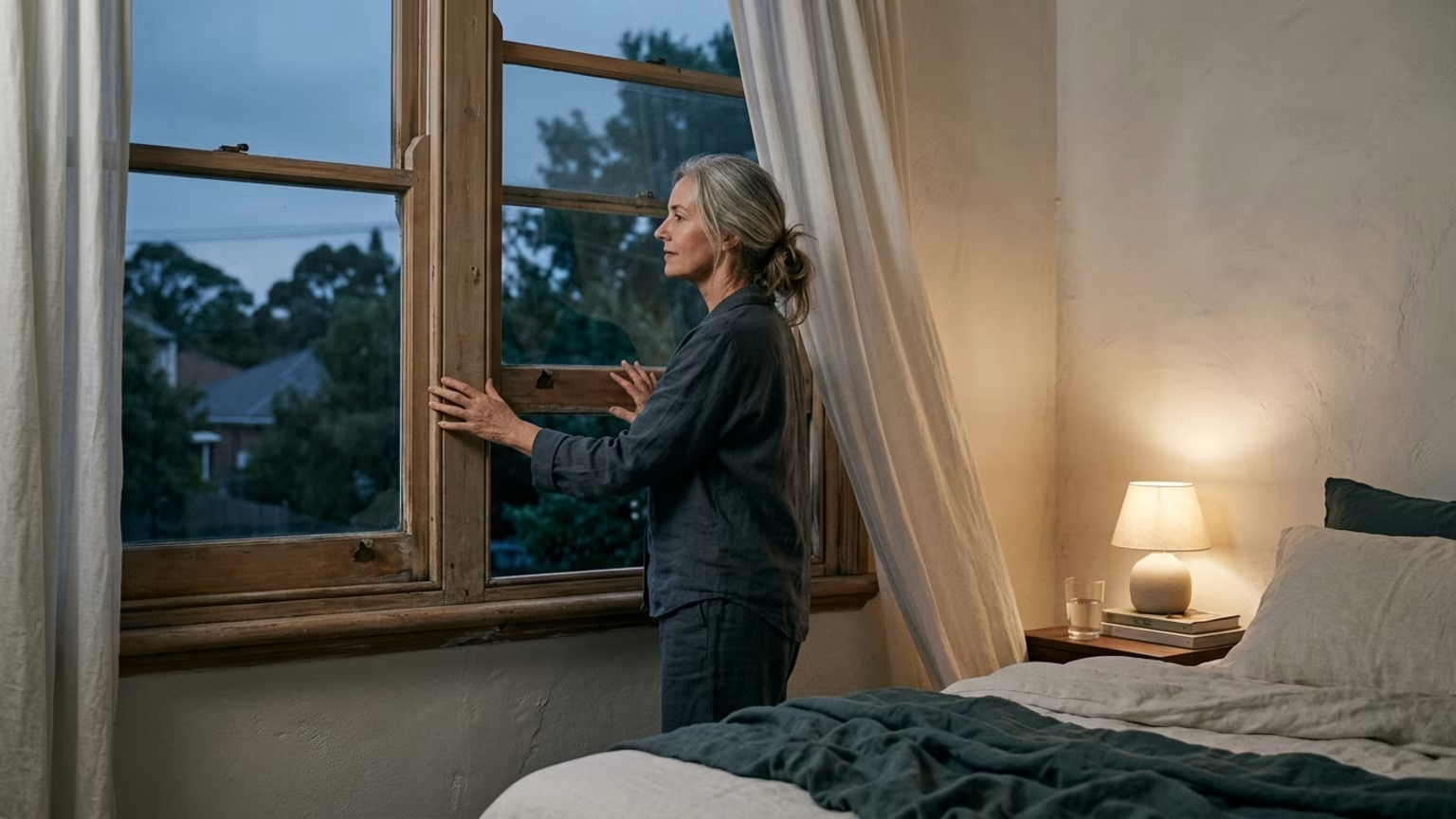
A reasonable, low-complexity experiment is to notice whether a bedroom that feels too warm is disrupting your sleep. You might consider modestly improving ventilation if you frequently wake up uncomfortable. The BBC mentions opening a window as something that might be worth a try. This action serves as a simple comfort adjustment rather than a proven circadian treatment.
The goal is to remove physical barriers to rest without turning your bedroom into a complicated optimization project. Many adults find that managing stress, mental overload and sleep timing involves basic physical comfort first. It does not require manipulating room temperature to resolve insomnia, chronic stress, or low daytime energy.
As researchers continue to separate biological timing from basic physical comfort, how might emerging data on environmental temperature reshape our long-term approach to midlife recovery?
Addressing low daytime energy and inconsistent recovery requires looking past rigid bedroom optimization rules, and Relaxopia details the actual habits that shape everyday rest. Confusion about circadian rhythm, light exposure and sleep timing often complicates evening routines, and the publication provides research-led editorial guidance without wellness hype to help adults over 35 find reliable comfort.
Stay connected for research-led guidance on sleep quality, stress, circadian rhythm, recovery, fatigue and everyday energy. Clear ideas for adults 35+ who want to sleep better, recover more fully and feel more capable through the day.





Explore practical guidance on sleep, stress and recovery without chasing every new hack, device or promise.
explore the blog