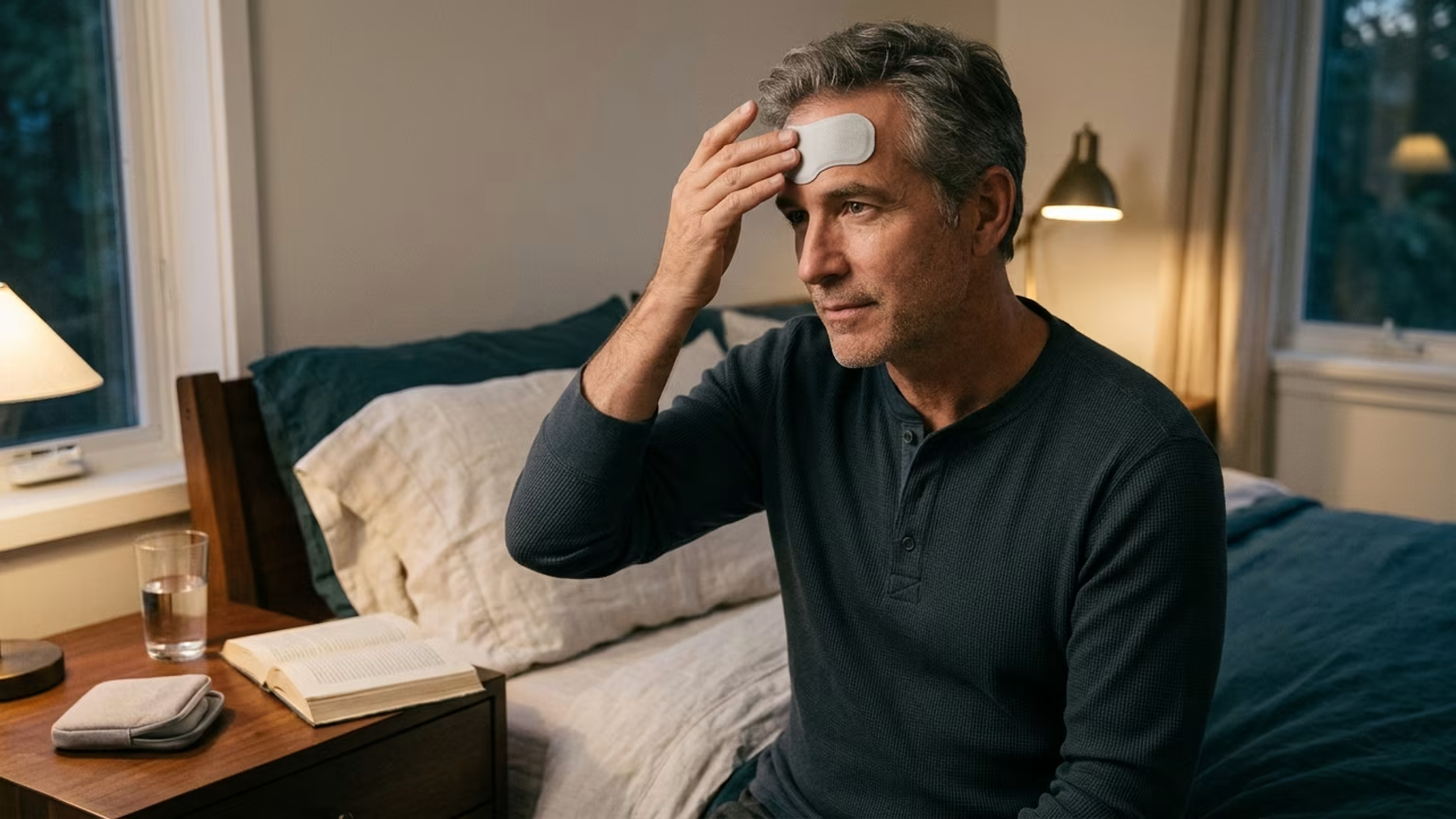

A forehead patch pairs brain-signal tracking with timed sound and cooling. Understand the early evidence and its relevance to midlife recovery.





On 2026-10-09, Medical Xpress reported on an experimental forehead patch being developed by sleep scientist William Coon at the Johns Hopkins Applied Physics Laboratory. The system combines brain-signal monitoring with timed sound and cooling intended to support deep sleep.
The project connects two tasks: identifying what is happening during sleep and using that information to time an intervention. Medical Xpress reports that the patch classifies sleep stages from forehead brain signals with accuracy matching a trained human scorer. Early pilot observations also pointed to a larger increase in slow-wave sleep when sound and cooling were combined than when either was used alone.
The patch is described as Band-Aid-sized and intended for home use. Its technical distinction is the signal it reads. According to the report, wrist-based fitness trackers do not directly measure brain activity. This patch is being developed to do that and then respond to the information.
That makes the research more than a proposal for another morning sleep score. The intended system would use information during the night to decide when to act. Measuring sleep and changing sleep remain separate research questions, however, and each needs its own evidence.
Medical Xpress reports that the team trained its model on more than 11,000 overnight recordings from the National Sleep Research Resource. That public archive supplied the recordings used for model training.
The proposed intervention then depends on timing. The system detects bursts of slow-wave activity and coordinates soft auditory clicks with them. The report explains that this approach can amplify slow waves already present rather than create them from nothing.
Cooling is the other proposed component. Instead of following a timer set around bedtime, it would be coordinated with real-time sleep data. The central idea is that an intervention should respond to the sleeper's current state rather than assume that getting into bed and falling asleep happen together.
The combined sound-and-cooling observation is the project's most directly relevant early finding for people interested in deeper sleep. It raises a research question about whether coordinating different interventions could produce a more useful effect than applying either alone.
The Medical Xpress report leaves several details unresolved. It gives no independent validation details for the human-scorer comparison. The more than 11,000 recordings are a model-training total, not a clinical-trial participant count. The report does not state how many people contributed those recordings or describe their demographics.
For the combined-intervention pilot, it provides no participant count or numerical effect size. It also gives no control-group details, randomization, blinding or statistical results. Those omissions prevent readers from judging the size and reliability of the reported increase.
Clinical efficacy remains to be established. The report supplies no diagnosed-insomnia group or insomnia symptom outcomes. It provides no comparison with an established insomnia treatment and no evidence of long-term health benefit. It also gives no commercial availability, price or regulatory-clearance information.
These are distinct gaps. A model's ability to label a sleep stage does not establish treatment benefit. An observed change in slow-wave sleep also needs to be connected to outcomes that matter beyond the recording itself.
Coon explained the timing problem in the Medical Xpress report:
> “If your system is timed to when you go to bed, but you don't fall asleep for an hour and a half, it's totally misaligned with your sleep,”
His point concerns the proposed system's logic. A bedtime setting follows the clock. A brain-signal-based system is intended to follow sleep as it unfolds.
For an adult who spends time awake after getting into bed, that distinction is easy to understand. A scheduled intervention and a sleep-responsive intervention are not the same design. The researchers are trying to make the timing responsive rather than simply make the device smaller or add another display of overnight data.
This is the useful technical question behind the AI label: what decision does the model help the system make? Here, the proposed answer is identifying sleep stages and helping coordinate sound and cooling with the sleeper's current state.
For an adult aged 35 to 65, the practical adjustment is not to reproduce the experiment at home. It is to change how a sleep measurement enters the day: treat it as information to interpret rather than a target that must be raised.
If a tracker score is already part of the morning routine, a useful companion is a plain-language account of the night and the following day. Did sleep feel restful? Was daytime tiredness getting in the way of ordinary responsibilities? Those questions keep the focus on the experience that technology is meant to help.
The purpose is context, not another record to maintain perfectly. Someone managing work and caregiving does not need to turn every morning into a review of sleep-stage totals. Relaxopia's discussion of putting wearable sleep scores in perspective offers a related way to approach those numbers.
A later article carried the headline “A Tiny Forehead Patch Could Help You Get More Deep Sleep”. The word “could” describes a possibility. It does not tell an individual reader what benefit to expect.
A practical way to read technology coverage is to separate three claims:
For this project, the first claim concerns forehead brain signals and sleep-stage classification. The second concerns timed clicks and coordinated cooling. The third is the outcome readers ultimately care about: whether the approach helps people sleep and function better.
Keeping those questions separate prevents a technical achievement from becoming a broader health claim simply through the wording of a headline. It also gives readers a clear way to assess the next update without needing to understand every detail of the model.
The cooling component is not a household temperature recommendation. It describes a proposed intervention coordinated with brain-signal data. Choosing a comfortable bedroom temperature is a different decision from testing a system that changes cooling in response to sleep.
The same distinction applies to sound. Playing clicks in a bedroom does not reproduce a system designed to detect slow-wave activity and time its response. The practical reading of this report is not to assemble a do-it-yourself version from separate products.
There is also no need to turn the announcement into a purchasing task. A useful response to developing technology can be to understand its purpose and wait for evidence relevant to the problem someone actually wants help with.
For someone whose sleep problems persist, this research belongs alongside technology news rather than in place of professional evaluation. Decisions about an individual's symptoms belong with qualified care.
A description of the lived problem is useful here: trouble falling asleep, waking during the night or feeling poorly restored during the day. That keeps the conversation centered on the difficulty itself rather than on obtaining a particular device.
The daily adjustment is therefore modest. Give personal experience space beside any existing sleep data, and keep care decisions separate from enthusiasm about an experimental tool. There is no requirement to become a more intensive tracker user to follow this research thoughtfully.
Medical Xpress reports that ARPA-H launched its six-year REST program in June 2026 and that Coon's team secured a contract through it. At the time of the report, new prototypes were expected later in 2026 ahead of a planned multiyear clinical study. The report did not specify that study's sample size, protocol or start date.
The next useful update will be about more than a smaller patch or a stronger AI description. For adults in midlife, the meaningful questions concern the connection between an overnight change and daily recovery. Research that follows that connection would help readers judge the system against their actual reason for wanting better sleep.
Comfort and the effort required to use a device also deserve attention when judging a home-use concept. These are practical questions for future evaluation, not assumptions about how this prototype will perform. A technically interesting system still has to find a useful place in ordinary life.
If brain-responsive sound and cooling eventually produce meaningful benefits, could midlife recovery care move toward tools judged by better daily functioning rather than by a larger deep-sleep number alone?
A higher slow-wave sleep reading needs interpretation, and Relaxopia explains the research behind such measurements with clear limits on health claims. Adults 35+ weighing unfamiliar wearables and recovery technology get evidence-based context for understanding the gap between a device feature and better everyday rest.
Stay connected for research-led guidance on sleep quality, stress, circadian rhythm, recovery, fatigue and everyday energy. Clear ideas for adults 35+ who want to sleep better, recover more fully and feel more capable through the day.






Explore practical guidance on sleep, stress and recovery without chasing every new hack, device or promise.
explore the blog