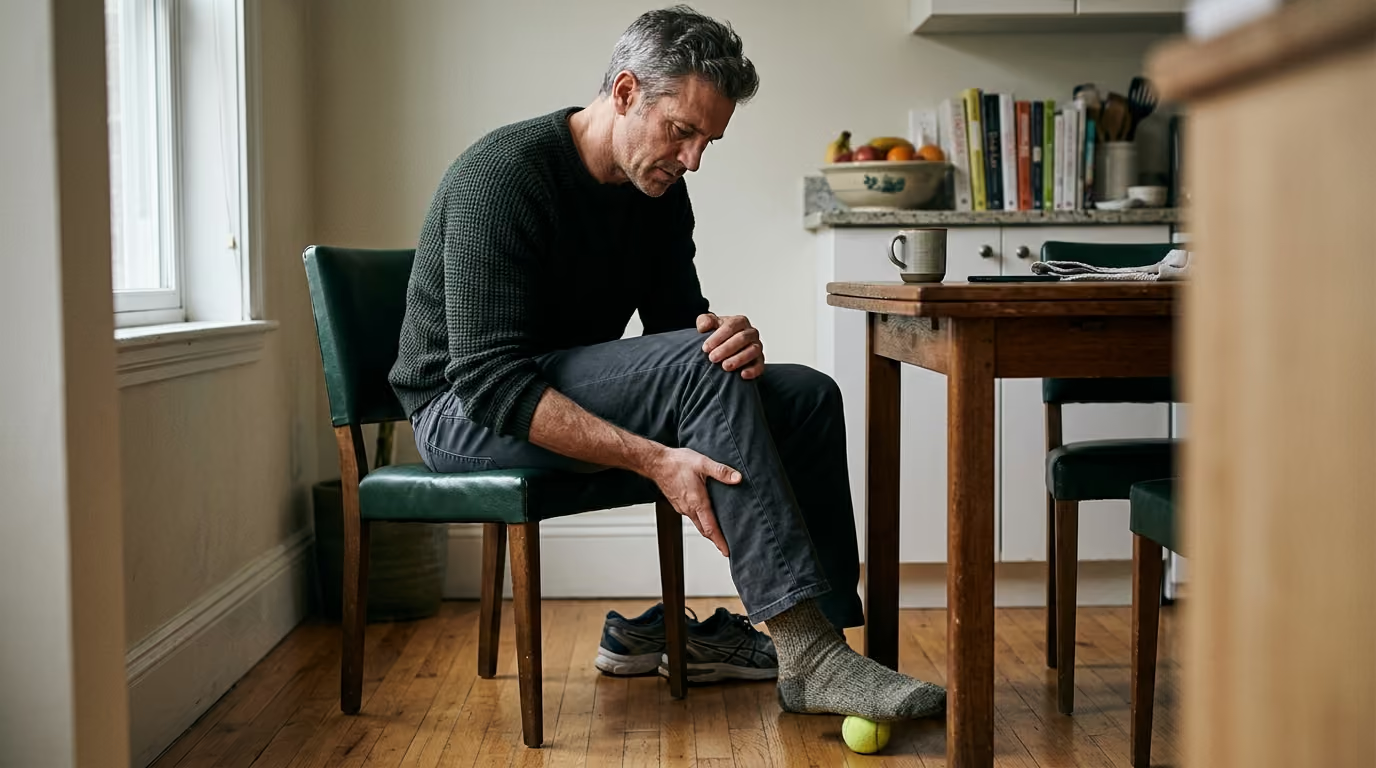

One-hour clock shifts create an immediate gap between social schedules and internal circadian timing, increasing cardiovascular risks and accident rates.





Standard time is the civil clock arrangement designed to approximate solar time during the darker portions of the year. Daylight saving time advances civil clocks by one hour, moving clock-measured daylight into the evening while delaying morning light. This guide examines the physiological differences between these two time systems, outlines what published research demonstrates about seasonal clock changes, and provides practical steps to protect your sleep.
The debate over standard time and daylight saving time is not merely a preference for morning light over evening light. It reflects a fundamental tension between social scheduling and human biology. Scientific interest centers on how changing the clock alters our exposure to the natural light-dark cycle.
Credible evidence in this field comes from two main areas. The first consists of laboratory circadian physiology, which provides strong data on how light shifts our internal clock. The second consists of population epidemiology, which provides observational data on sleep duration, motor vehicle accidents, and cardiovascular events around seasonal transitions.
Major medical and scientific organizations have reviewed this literature. The American Academy of Sleep Medicine and the British Sleep Society both support permanent standard time. They state that aligning social schedules with natural solar morning light supports healthier sleep and circadian alignment.
At the same time, the broader evidence base remains nuanced. While acute disruptions during the spring transition are well documented, long-term studies comparing permanent standard time against permanent daylight saving time remain limited. Understanding this distinction helps separate biological facts from policy speculation.
To understand why clock shifts disrupt daily function, it helps to distinguish among three distinct time systems:
When civil time moves forward by one hour in the spring, solar time does not change. Your internal biological clock also remains set to the previous schedule. This creates an immediate gap between when society expects you to wake up and when your body is biologically prepared to do so.
Human sleep is regulated by two interacting systems. The first is sleep pressure, also known as sleep homeostasis. Sleep pressure builds steadily during every hour of continuous wakefulness and dissipates during sleep.
The second system is circadian alerting, which is coordinated by the suprachiasmatic nucleus in the brain. The suprachiasmatic nucleus directs daily rhythms in core body temperature, alertness, cortisol, and melatonin secretion. These rhythms operate on an approximately 24-hour cycle.
A clock change does not alter your baseline need for rest. Instead, it forces social obligations to occur at an unaligned point in your circadian cycle. Learning more about circadian rhythm and sleep timing resources can clarify how these two internal systems coordinate daily recovery.
Light is the primary environmental signal that synchronizes the master circadian clock to the 24-hour day. This synchronization process is known as circadian entrainment. While meals, exercise, and social routines provide secondary timing signals, ocular light exposure remains the primary driver.
The timing of light exposure determines its physiological impact. Circadian biologists describe this relationship through the phase-response curve to light. Light received at different points in your biological cycle produces entirely opposite physiological adaptations.
Bright light exposure in the biological morning produces a phase advance. A phase advance shifts your internal rhythm earlier, making it easier to fall asleep earlier in the evening and wake up earlier the next day. Morning sunlight reaching the retina signals the suprachiasmatic nucleus to set its daily timer.
Light exposure during the biological evening or early night produces a phase delay. This shifts your internal clock later, delaying natural melatonin release and pushing back the time you feel sleepy. Melatonin timing is often measured in research settings as dim-light melatonin onset, which marks the start of the biological night.
Daylight saving time shifts sunrise later by the civil clock. For an adult waking at 6:30 a.m. the sun may not yet be up after the spring transition. Waking in darkness deprives the brain of its morning resetting cue, while prolonged evening light encourages later bedtimes.
The two annual clock transitions present distinct physiological challenges. Moving clocks forward in the spring is widely recognized as the more disruptive shift. Returning to standard time in the autumn presents a different set of challenges.
When civil clocks advance by one hour in the spring, the nominal day shrinks to 23 hours. People must wake up an hour earlier relative to their biological rhythm. A person waking at 6:30 a.m. on Monday is waking when their internal clock feels like 5:30 a.m.
Research shows that people rarely advance their bedtime by an hour on the weekend of the transition. Studies analyzing objective sleep recordings show that workers lose an average of roughly 40 minutes of sleep on the nights following the spring change. Sleep latency increases, and sleep fragmentation rises across the entire following week.
In the autumn, clocks move back by one hour, creating a 25-hour nominal day. This shift provides an extra hour of potential rest. Many individuals use this change to catch up on accumulated sleep debt.
However, the autumn transition is not biologically neutral. People who maintain their previous sleep routine may wake up earlier than their alarm requires. If an individual stays up later to take advantage of the extra hour, their circadian rhythm can drift later, reducing morning light exposure during subsequent workdays.
Public health researchers have studied how seasonal time changes correlate with acute health and safety events. These investigations examine medical records, traffic databases, and workplace injury reports.
One well-documented study reported a 5.7% increase in workplace injuries on the Monday immediately following the spring transition. Workers experienced greater lost-work days due to these injuries compared to other Mondays. Acute sleep loss and reduced morning alertness appear to drive this increase.
Motor vehicle collisions show similar patterns in several datasets. Early reviews identified short-term increases in fatal traffic crashes of up to 30% on the day daylight saving time began. Subsequent analyses suggest smaller or mixed effects across different regions, but the risk remains elevated during the morning commute when drivers are sleep-deprived and commuting in darker conditions.
The link between daylight saving transitions and acute myocardial infarction has drawn extensive research attention. A 2024 meta-analysis found a pooled relative risk of 1.04 for acute myocardial infarction following the spring transition. The same meta-analysis found a pooled relative risk of 1.02 following the autumn transition, with noticeable variation across the included studies.
Recent large-scale investigations show that this relationship is not uniform across all populations. A 2025 analysis from Duke University examined nearly 170,000 patient records across multiple years. That study found no statistically significant increase in heart attacks, strokes, or hospital deaths during the weeks surrounding either time change.
These divergent findings show why cardiovascular outcomes should be characterized as statistical associations rather than definite causal links. Population health is influenced by baseline sleep debt, regional weather, commuting habits, and healthcare access.
The physiological strain of a clock change is not felt equally by all individuals. Differences in genetics, chronotype, age, work schedules, and family roles shape how easily someone adapts.
Evening chronotypes naturally generate melatonin later in the night and prefer later sleep and wake times. When the spring transition occurs, evening types struggle to fall asleep earlier. They experience higher rates of social jetlag, morning sleepiness, and daytime fatigue.
Adolescents naturally undergo a biological circadian delay during puberty. Early high school start times already compress their sleep opportunity. Advancing the civil clock in the spring worsens this deficit by requiring them to wake during their biological night.
As people age, circadian rhythms naturally shift earlier, and sleep architecture changes. Sleep becomes lighter, with less slow-wave rest and more nighttime awakenings. Understanding these changes in body clock timing after 35 helps explain why midlife adults often find recovery slower after a lost hour of rest.
Older adults may also struggle during the autumn transition. Those who wake early may find themselves waking at 4:00 a.m. by the new clock. Shifting an established schedule later can require deliberate light management.
Shift workers already live with circadian misalignment. When clocks shift, their work shifts may be lengthened or shortened by an hour, disrupting sleep routines and handoff safety protocols.
Parents of young children also experience unique friction. Infants and toddlers do not follow civil clock changes. They continue waking based on biological hunger, body temperature, and internal sleep pressure, requiring parents to adjust family routines gradually.
Rather than absorbing an abrupt one-hour change in a single night, you can adapt your physiology over several days. The National Institute for Occupational Safety and Health recommends shifting schedules by 15 to 20 minutes daily for three to four days before the transition.
To prepare for advancing the clock:
On the Monday following the change, allow extra time for your morning commute. Avoid scheduling safety-sensitive tasks or long drives when feeling unrefreshed. If daytime sleepiness peaks, a brief 20-minute nap before 2:00 p.m. can restore alertness without disrupting nighttime sleep.
To prepare for falling back to standard time:
Using a consistent wake-time strategy provides the suprachiasmatic nucleus with a reliable anchor point every single morning.
Individual circumstances dictate how these adjustments should be applied. Examining specific illustrative models clarifies how to handle common schedule challenges.
Consider a professional who naturally sleeps from 11:30 p.m. to 7:30 a.m. but must wake at 6:30 a.m. after the spring transition. If this person attempts an abrupt one-hour shift on Sunday night, they will likely lie awake until midnight and wake in a state of severe grogginess.
Instead, this individual should begin shifting their schedule four days earlier. They can move their wake time to 7:15, 7:00, 6:45, and finally 6:30 a.m. going outdoors for bright morning sunlight each morning. They should also finish dinner earlier and keep evening screen use to a minimum.
Consider an adult over 45 who naturally wakes at 5:00 a.m. After the autumn clock change, their internal clock wakes them at 4:00 a.m. by civil time. Lying in bed in frustration can create sleep-related anxiety and unwanted wakefulness.
This individual should deliberately delay their bedtime by 15 minutes each night before the transition. When waking early during the shift, they should remain in dim light, avoiding screens and bright overhead bulbs. Staying up in moderate light in the evening helps delay their circadian phase.
Many working adults arrive home feeling mentally drained yet physically under-stimulated. When daylight saving time begins, later evening daylight encourages staying active later, which delays winding down. When bedtime arrives, they often find their minds racing.
These individuals benefit from setting a firm evening transition window. Closing blinds, lowering indoor lights at 8:30 p.m. and engaging in calm activities signal the brain that night has begun. Reviewing practical strategies for why you feel tired but wired at bedtime can help ease the transition from daytime demands to restful sleep.
While circadian biology clearly explains how light affects the body, time-policy research has important limitations that require careful context.
Most published studies examine the acute disruptions caused by shifting clocks twice a year. These acute findings are sometimes used to argue against permanent daylight saving time or in favor of permanent standard time.
However, studying a sudden one-hour disruption does not show what happens when a population lives under a single, unchanging clock system for decades. Chronic outcomes under permanent daylight saving time have not been fully tested in modern, large-scale clinical trials.
The real-world effect of any time system depends heavily on latitude and position within a time zone. A person living on the eastern edge of a time zone experiences sunrise much earlier than someone living on the western edge. Winter daylight availability also varies widely between northern and southern regions.
Additionally, many epidemiological studies rely on retrospective registry data. These records can be influenced by changes in traffic enforcement, local weather, economic shifts, and hospital reporting practices. Claims regarding psychiatric disorders or all-cause mortality across clock changes show substantial inconsistency across systematic reviews.
Occasional fatigue or mild sleep disruption is normal for several days following a clock transition. Most adults adjust their biological rhythms within one to two weeks if they maintain regular wake times and manage light exposure.
When sleep difficulties persist beyond two to three weeks, they may point to an underlying sleep disorder rather than a simple clock adjustment issue. A comprehensive medical evaluation is worth considering if you experience:
A physician or board-certified sleep specialist can evaluate your symptoms, identify conditions like obstructive sleep apnea or insomnia, and provide structured, evidence-based treatments such as cognitive behavioral therapy for insomnia or guided phototherapy.
The annual debate over daylight saving time highlights a fundamental physiological reality: your body responds to the timing of natural light rather than the numbers on a clock. While society sets civil schedules, your circadian clock depends on regular morning sunlight, dim evenings, and consistent sleep habits to maintain daytime energy and long-term health.
The autumn transition provides an extra nominal hour of opportunity, which can help ease short-term sleep debt. However, research into catching up on sleep on weekends shows that extra sleep opportunity cannot fully compensate for chronic weekly sleep deficits. Early chronotypes may also wake at their usual biological time, missing the extra hour entirely.
People with late chronotypes, older adults, and those with baseline sleep debt adapt more slowly to phase advances. If an individual stays up late while facing early morning alarm times, they accumulate ongoing sleep debt. Without sufficient morning sunlight, the suprachiasmatic nucleus takes longer to synchronize with the new civil schedule.
Commercial bright light therapy lamps providing 10,000 lux can produce a circadian phase advance when used properly after waking. While natural outdoor sunlight offers a broader spectrum and higher lux levels even on cloudy days, light boxes are an effective alternative for individuals who must wake before dawn or work in windowless environments.
Major medical organizations like the American Academy of Sleep Medicine advocate for permanent standard time because it aligns clock noon more closely with solar noon. Standard time ensures earlier sunrise across winter months, providing morning light that prevents circadian delay and supports natural alertness for commuters and students.
Stay connected for research and practical guidance on sleep, stress, circadian rhythm and recovery. Clear ideas for adults 35+ who want better rest, steadier energy and more resilient days.



Explore practical guidance on sleep, stress and recovery without chasing every new hack, device or promise.
explore the blog