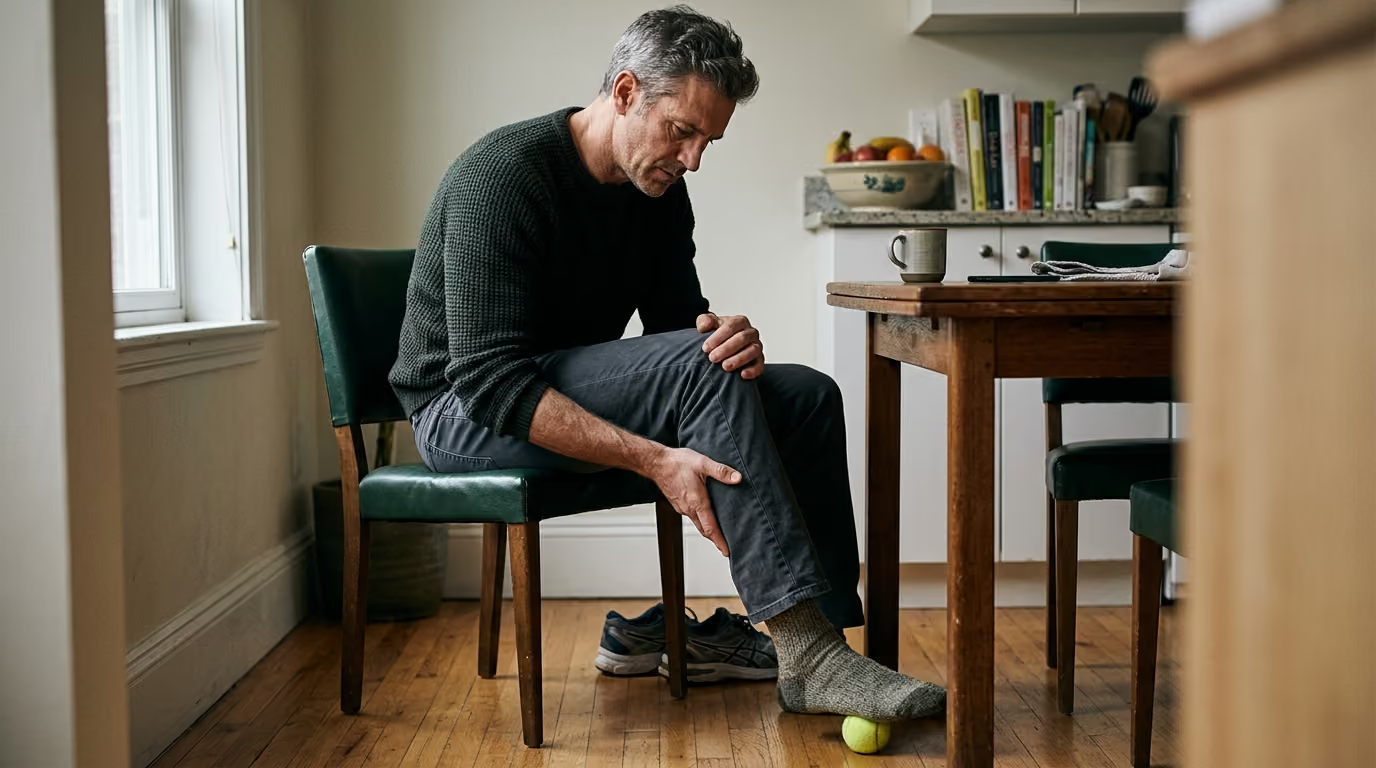

Accurate recovery tracking becomes sustainable when you evaluate functional trends across sleep, mood, and energy instead of obsessing over daily biometric scores.





If you are in immediate danger, call 911. For 24/7 support, call or text 988 and press 1 for the Veterans Crisis Line, or text 838255.
Many people search for answers when their daily routine feels heavy: "Why do I feel exhausted when my sleep tracker says I am fully recovered?" Others wonder why their recovery score is red when they feel ready to work. These contradictions create confusion and self-doubt.
This guide provides a definitive framework for evaluating your physical and psychological recovery. You will learn how to track functional capacity, interpret body signals, and use technology without letting numbers dictate your day.
Scientific research shows that recovery is not a single physiological metric. It cannot be reduced to a single proprietary readiness score. Recovery represents a multi-system return to baseline after physical, cognitive, or emotional demand.
Credible evidence in behavioral medicine and psychophysiology separates stress into three distinct phases. Ecological momentary assessment studies highlight reactivity, recovery, and pile-up. Reactivity is the immediate physiological response to a challenge. Recovery is the rate at which your systems return toward baseline. Pile-up is the cumulative burden when stressors occur before previous activations fully subside.
Recent systematic reviews show that subjective ratings and wearable metrics do not always correlate. Research examining daily experience sampling alongside physiological monitors shows moderate agreement for sleep duration and movement. The same studies find weak correlation between wearable metrics and perceived tiredness or emotional strain.
Evidence confirms that commercial wearables can track long-term trends in sleep timing and physical activity. Research also shows that consumer devices often struggle to measure sleep stages accurately. Many algorithms overestimate light sleep while underestimating deep and rapid eye movement stages.
The strongest evidence supports a balanced approach. Lived experience, daily functional capacity, and broad biometric trends should inform each other. No single data stream should dominate your health decisions.
Evaluating your recovery requires distinguishing between an immediate state and an ongoing trajectory. A state describes how you feel at a single moment. A trajectory describes your functional direction across several weeks.
A single poor night of sleep, an intense conversation, or a demanding travel day produces a temporary low state. These fluctuations are a normal part of biological life. They do not mean your nervous system is broken. They simply reflect the acute cost of living.
A trajectory reflects whether your overall resilience is growing, stable, or deteriorating. For adults navigating complex professional and personal responsibilities, tracking trajectories prevents overreaction to normal daily fatigue. You can learn more about managing these shifts in our guide to why recovery feels slower with age.
When you focus only on daily states, minor variations look like medical problems. You might change your schedule, cancel social events, or spend unnecessary time in bed chasing a recovery score. This hyper-vigilance creates its own stress response.
Tracking trajectories allows you to evaluate patterns over two to four weeks. You look for whether you settle faster after stress than you did last month. You observe whether your energy is predictable across the workweek. This long view provides clarity without daily panic.
To assess recovery without compulsive monitoring, focus on observable functioning across six primary areas. These dimensions show how your body and mind handle daily life.
Sleep tracking should focus on how sleep functions rather than chasing numerical perfection. Total hours in bed matter less than continuity and how restored you feel upon waking.
The Centers for Disease Control and Prevention notes that adults require at least seven hours of sleep per night. Large public health datasets show that over thirty percent of adults average fewer than seven hours. Data also reveal that over eighteen percent struggle with sleep maintenance, while fifteen percent have trouble falling asleep.
These findings show that sleep quantity alone is an incomplete measure. When reviewing sleep continuity, notice these specific indicators:
Evaluating these signs weekly gives a clear picture of sleep health. You can explore deeper sleep architecture principles in our section on improving sleep quality.
Healthy recovery does not mean you feel cheerful every hour. A resilient nervous system experiences frustration, grief, anger, and worry, then returns to an emotional baseline.
When recovery is compromised, emotional regulation becomes brittle. Small inconveniences trigger intense reactions, or you might experience persistent numbness and dread.
Observe these indicators over a two-week window:
Standardized clinical screening tools like the World Health Organization Five Well-Being Index evaluate these patterns over fourteen-day periods. They do not ask people to log every mood shift. They measure overall well-being and vitality across a broad window.
Cognitive fatigue is a reliable indicator of incomplete systemic recovery. When your nervous system remains in sustained activation, executive functioning declines.
Public health guidelines identify concentration problems, forgetfulness, and indecisiveness as common mental signs of sustained stress. Measuring your cognitive recovery does not require complex brain training apps. It requires honest reflection on daily performance:
Distinguish between temporary mental load and persistent cognitive decline. A difficult project will produce short-term mental fatigue. Incomplete recovery shows up when cognitive strain persists even after rest periods.
Energy should be evaluated across an entire day rather than judged solely during morning grogginess. Sleep inertia naturally makes many people feel slow for the first thirty minutes after waking.
A functional energy profile shows predictability. You might experience a normal post-lunch dip, but you maintain enough vitality to finish the afternoon without excessive stimulants.
Notice whether your daily energy matches these patterns:
When physical energy is consistently low, review context before assuming your nervous system is dysregulated. Nutrition, hydration, sedentary routines, and chronic workload play significant roles. For practical strategies on balancing autonomic strain, visit our resources on nervous system balance and rest.
Encountering stressors is inevitable. The defining characteristic of recovery is how quickly your body and mind deactivate once the challenge ends.
Research shows that high stress reactivity directly undermines sleep continuity. Poor sleep quality then increases negative emotional reactivity the following day. This bidirectional relationship can create a persistent cycle of exhaustion.
Review your stress response using general time categories:
The goal is not to eliminate physiological arousal during a challenge. The goal is to prevent stress responses from lingering long after the event has passed. You can read more about structured decompression in our analysis of psychological detachment after demanding days.
The ultimate test of recovery is whether you can participate in life without paying an unsustainable physical price. Functional recovery shows up in how you handle everyday responsibilities.
Evaluate your capacity across these routine areas:
When recovery is poor, people begin organizing their entire lives around avoiding symptoms. They decline basic invitations, neglect home environments, and rely on emergency coping mechanisms. Tracking real-world capacity keeps your assessment grounded in functional reality.
Consumer wearables offer interesting data, but they must be interpreted with scientific literacy. A device provides an algorithmic estimate based on surface sensors, not a definitive medical evaluation.
Modern wrist-worn wearables perform well in specific measurement areas. Validation studies show that many consumer devices detect sleep and wake timing with accuracy comparable to research-grade actigraphy.
Wearables can reliably help you identify:
When used to observe macro trends over thirty to ninety days, wearable data can highlight useful behavioral patterns.
The primary weakness of consumer devices lies in sleep staging and proprietary recovery algorithms. Most commercial devices attempt to calculate light, deep, and rapid eye movement sleep using movement, optical heart rate sensors, and skin temperature.
Independent sleep laboratory reviews show substantial validation gaps in these staging algorithms. Commercial devices frequently misclassify wakefulness as light sleep. They also struggle to differentiate accurately between deep slow-wave sleep and rapid eye movement sleep.
Proprietary readiness scores combine several physiological variables into a single number. These algorithms are trade secrets, meaning their mathematical weightings cannot be independently audited by medical researchers.
A readiness score can be skewed by minor changes in skin temperature or temporary shifts in autonomic tone. Letting a proprietary formula decide your daytime capability is scientifically unsound.
Overmonitoring can actively undermine your recovery. When tracking becomes compulsive, it generates a clinical phenomenon known as orthosomnia.
Orthosomnia describes an unhealthy preoccupation with achieving perfect wearable data. People with orthosomnia experience rising anxiety about their sleep scores, which increases physiological arousal and directly causes insomnia.
Watch for these warning signs of measurement anxiety:
If tracking increases self-doubt or emotional rigidity, the monitoring protocol is harming your recovery. You can find broader perspectives on mental balance in our collection on mental resilience and stress management.
To prevent measurement fatigue, adopt a minimum effective monitoring system. Your assessment routine should take almost no time and should rely on descriptive reflections rather than complex spreadsheets.
The most sustainable approach is a single weekly review. Set aside three minutes every Sunday to evaluate your previous seven days across the core functional dimensions.
Rate your week using three simple categories:
Ask yourself these six questions:
This review captures trends without encouraging daily hyper-fixation.
If you prefer daily tracking, restrict your protocol to a brief check-in at a consistent time. Perform this check-in in the late afternoon rather than immediately upon waking.
Rate these four items on a simple scale of one to five:
Log your ratings once and close your journal. Do not re-evaluate your score during the evening.
When testing a new lifestyle adjustment, track only the specific variable you are modifying. Limit the experiment to fourteen days to maintain perspective.
Structure your experiment around three elements:
Review the outcome after two full weeks. Decide whether to maintain the habit, modify it, or discard it based on functional results rather than biometric perfection.
A frequent challenge occurs when wearable data contradicts how you actually feel. A structured disagreement protocol prevents unnecessary confusion.
If your wearable shows a low readiness score but you wake feeling refreshed, alert, and capable, follow these steps:
Your direct functional capacity is always more reliable than an indirect algorithmic estimate.
If your tracker displays a peak recovery score but you feel deeply fatigued, unfocused, and overwhelmed, follow these steps:
Wearables measure specific physiological variables, not the complete human experience.
Measuring recovery effectively requires avoiding common cognitive and behavioral traps. These errors often turn helpful tracking into an exhausting chore.
A racing pulse, temporary muscle tension, and brief mental agitation are normal biological responses to acute challenges. They indicate that your autonomic nervous system is responding to the environment.
Do not interpret every sign of physiological arousal as nervous system dysregulation. A healthy system mobilizes energy when required and calms down when the demand ends. Recovery is about the return to baseline, not the total absence of arousal.
A statistical average can conceal severe functional volatility. If you experience four days of extreme energy followed by three days of total physical collapse, your weekly average might appear normal.
Look at the stability of your routine alongside your averages. A consistent, moderate energy pattern is more sustainable than high peaks followed by severe crashes.
Many people diligently track their health behaviors while ignoring whether those behaviors actually help. They record meditation minutes, supplement intake, cold showers, and strict bedtimes without assessing their lived vitality.
Health habits are tools, not goals in themselves. If an elaborate routine does not improve your sleep continuity, mood stability, or daily capacity, simplify it. Measure how you function in the world, not how perfectly you execute a wellness routine.
People often record every poor night of sleep, headache, or anxious thought while ignoring signs of growing capacity. This negative bias distorts your perception of recovery.
Actively notice positive functional indicators:
Recognizing these markers gives a balanced, accurate view of your overall trajectory.
Recovery capacity is dynamic. It changes based on biological stage, environmental conditions, and life demands. Adjust your expectations when these factors are present.
As adults cross age thirty-five, physiological systems undergo natural shifts. Cellular repair mechanisms, growth hormone secretion, and circadian signal strength change gradually over decades.
These biological transitions mean that sleep architecture naturally becomes lighter. Recovery after intense physical exertion or sustained mental workload requires more deliberate pacing. These changes are a normal part of maturation, not personal failures.
Recovery does not happen in a vacuum. High baseline demands reduce the physiological resources available for physical repair.
Consider the cumulative impact of these common life factors:
When life load is elevated, your recovery system must be adapted. Expecting peak physical performance during periods of heavy emotional or caregiving strain creates unrealistic pressure.
Self-monitoring is designed for everyday lifestyle management. It is not a substitute for clinical diagnosis or medical care.
Public health guidelines from the National Health Service emphasize that medical evaluation is necessary when stress, anxiety, or fatigue impairs daily functioning or fails to improve with basic lifestyle measures.
Schedule a consultation with a qualified healthcare provider if you experience any of the following:
If you are experiencing thoughts of self-harm or suicide, immediate support is available. In the United States and Canada, call or text 988 to reach the Suicide & Crisis Lifeline, or call 911 for immediate emergencies. In the United Kingdom, call 111 or reach emergency services at 999. If you are a veteran in the United States, call 988 and press 1, or text 838255.
Arrange safety measures, including securing medications and removing access to lethal means, in collaboration with a trusted clinician, family member, or friend. Self-monitoring tools should support your well-being, never delay appropriate medical evaluation.
To transition away from overmonitoring and build a calm, sustainable recovery assessment habit, apply this practical checklist over the coming week:
Measuring recovery is meant to serve your life, not consume it. When you focus on functional capacity, emotional stability, and long-term trends, you gain actionable clarity without the burden of constant measurement.
Stay connected for research and practical guidance on sleep, stress, circadian rhythm and recovery. Clear ideas for adults 35+ who want better rest, steadier energy and more resilient days.



Explore practical guidance on sleep, stress and recovery without chasing every new hack, device or promise.
explore the blog