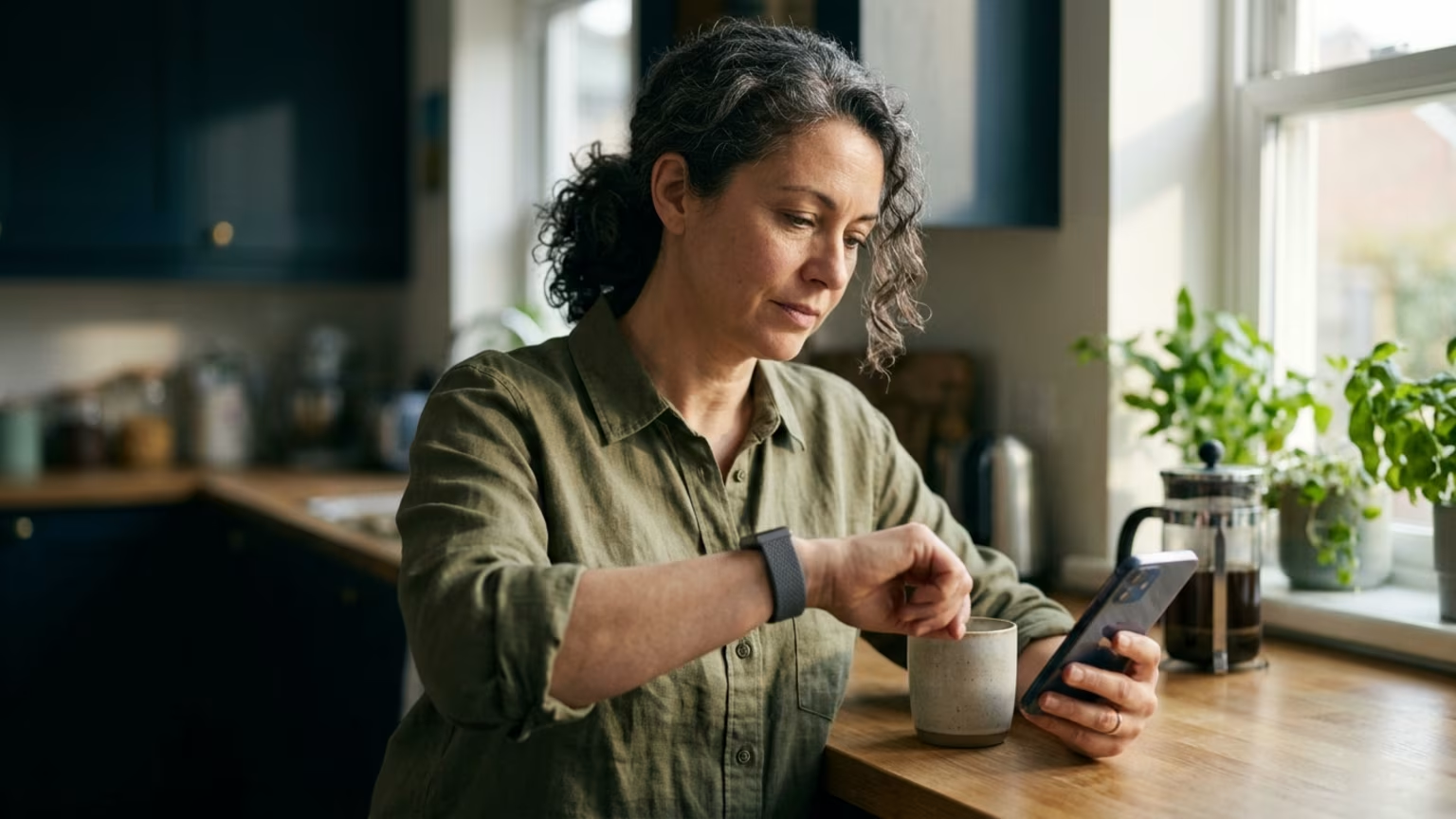

A one-week wearable comparison shows that Apple and Garmin sleep scores can differ by over 30 points. Learn why algorithms vary and how to manage sleep data.





In late September and early October 2026, a reviewer tracked their sleep for a week using an Apple Watch Series 12 on one wrist and a Garmin Cirqa on the other. The comparison, reported by TechRadar and reproduced by Carmona.mx, demonstrated that two major platforms can produce widely different nightly sleep scores for the exact same night.
The TechRadar reviewer documented substantial differences in how the two devices interpreted a single night of rest. The largest reported gap occurred on the very first night of the test. On September 26, the Apple Watch awarded a sleep score of 93 while the Garmin device returned a score of 62. This 31-point difference highlights how different platforms use proprietary algorithms to evaluate the exact same physical rest period.
Another conspicuous discrepancy appeared toward the end of the one-week trial. On October 1, the Garmin device generated a sleep score of 87 while the Apple Watch returned a score of 68. The other nights of the trial also showed daily variations that kept the reviewer guessing. On September 27, the devices recorded scores of 67 and 56 for Garmin and Apple.
The scores for September 28 were 78 and 82, followed closely by 95 and 84 on September 29. The remaining nights followed a similar pattern of variation with scores of 77 and 72 on September 30 and 87 and 83 on October 2. These daily fluctuations show that one platform is not universally scoring higher or lower than the other on a consistent basis. The variations represent fundamental differences in how each system categorizes physiological data on any given night.
The variation in these nightly scores aligns with broader findings regarding how well consumer wearables identify specific biological states. A secondary summary of a 2024 polysomnography validation study reported by Welltory examined three distinct platforms: the Oura Ring Gen3, the Fitbit Sense 2 and the Apple Watch Series 8. The summary indicated that sleep versus wake sensitivity was at least 95 percent for all three tested devices. This means modern wearables are highly proficient at determining whether a person is actually asleep or staring at the ceiling.
When adults deal with difficulty falling asleep, these devices can accurately log that wakefulness. However, the same validation study summary noted that sleep stage sensitivity varied much more widely across the hardware. The ability to identify specific sleep stages accurately fluctuated between 50 and 86 percent across the tested devices and stages. Because manufacturers weigh these individual sleep stages differently in their software, the resulting nightly scores can diverge significantly.
While the daily scores showed distinct differences, the broader assessment over time painted a more unified picture of the reviewer's week. The TechRadar article referenced a massive Terra analysis that examined 77,000 nights of data across six different wearable companies. This large-scale analysis found broad convergence on general sleep duration and overall trends. Most platforms agree on roughly how long you spent in bed even when they struggle to categorize the microscopic details.
The analysis noted substantially weaker agreement regarding individual sleep stages. For adults who focus heavily on getting enough deep sleep or REM sleep, this data points to a clear reality. Consumer wearables are still guessing at the exact boundaries between these specific physiological states. This reinforces the idea that platforms consistently agree on the broad shape of your rest while disagreeing on specific stage times.
This convergence on broader trends extends to the platforms' overall readiness assessments. At the end of the testing period, the reviewer received readiness scores that they interpreted as comparable. Apple provided a readiness rating of 7 out of 10 while Garmin gave a score of 70 out of 100. While these platforms utilize entirely different measurement scales, the reviewer found that their broader interpretations of the week aligned closely.
For adults managing low daytime energy, a single wearable score should act as one piece of context rather than an absolute verdict on daily recovery. Apple states that its Readiness feature combines a sleep score with recent activity, training load and vital signs. This integrated approach is intended to help users gauge their physical capacity for the day ahead. Moving beyond sleep in isolation requires looking at the broader physical picture.
Because this complex system requires a reliable baseline to function properly, Apple specifies that users need seven nights of sleep data before receiving a readiness score. Those seeking to understand their rest must allow their devices time to gather sufficient background data before reacting to the numbers. A typical adult juggling professional stress and exercise cannot rely on a single night of tracking to explain their entire fatigue profile. Time and consistency remain required elements for accurate technological assessment.
Understanding the relationship between your sleep data and your daily capacity requires looking at sustained patterns. According to Apple's support guidance, poor-quality or inconsistent sleep can directly lower your readiness score. Conversely, a high or improved sleep score can actively raise it. This mechanical relationship means that an unusually low score on a single night will impact your daily metric.
An impacted daily metric does not mean your biological recovery process has completely failed. Adults should avoid treating a single isolated number as a definitive measure of their physical state. When adults 35 and older evaluate their daily fatigue levels, combining digital data with physical reality becomes critical. The practical implication of the TechRadar review is that users should not fixate on precise readings from one specific night.
Instead of fixating on isolated numbers, users should closely consider how rested and functional they actually feel during the day. If a device reports a poor night of rest but you feel alert and capable, your subjective experience remains a valid indicator of your recovery. Devices provide estimates based on generalized models while your body provides immediate biological feedback. Checking a digital score should validate your physical feeling rather than dictate it.
For many adults, the constant presence of health technology introduces a persistent mental load that makes it hard to switch off at night. If checking a digital score creates worry, the reviewer explicitly suggests taking occasional untracked nights. Removing the wearable device periodically can relieve the pressure to achieve a high score before bed. This approach helps adults rebuild trust in their own biological signals without facing immediate external judgment in the morning.
Integrating tools like the Apple Watch Series 12 into a healthy routine requires sensible boundaries. An occasional night without tracking is a reasonable adjustment for anyone experiencing sleep-score anxiety or frustration. Relying on consistent trends over weeks or months keeps the focus on genuine physical restoration. The ultimate goal of using recovery technology is to support a stable daily routine rather than generating flawless digital metrics every single night.
The clear divergence in sleep scores between major platforms highlights the ongoing challenge of quantifying human rest accurately. While sensors continue to improve their ability to detect precise physiological changes, algorithms still interpret that data through proprietary mathematical models. As technology companies continue to refine these tracking systems, users face the task of integrating digital metrics without letting them override physical sensation. How will the next generation of adults balance increasingly detailed digital recovery metrics with the simple, subjective reality of waking up and feeling ready for the day?
Learning that major platforms can produce widely different sleep scores often leaves adults questioning the value of their daily health metrics. By evaluating current clinical research, Relaxopia helps you address uncertainty about sleep trackers, wearables and new recovery technology so you can make informed decisions about your routine.
Stay connected for research-led guidance on sleep quality, stress, circadian rhythm, recovery, fatigue and everyday energy. Clear ideas for adults 35+ who want to sleep better, recover more fully and feel more capable through the day.



Explore practical guidance on sleep, stress and recovery without chasing every new hack, device or promise.
explore the blog