
A 2026 BBC Future report reveals how evening cooling, daytime light, and social transitions shape human sleep. Learn practical adjustments for midlife recovery.





On September 24, 2026, BBC Future published an article examining what contemporary foraging societies may reveal about human sleep. The report focuses primarily on the Hadza of Tanzania, the Tsimane of Bolivia, and the San of Namibia. These communities offer researchers a window into human rest before electric lighting and modern indoor environments became standard. The underlying field research is observational and ecological.
The primary conclusion of this research highlights that human sleep timing tracks environmental changes closely. Specifically, sleep in these groups appears to track nighttime temperature declines more closely than artificial light alone. A 2015 Current Biology study recorded sleep in 94 adults across 1,165 participant-days. The recorded sleep duration averaged approximately 5.7 to 7.1 hours, occurring as one consolidated nighttime period.
Sleep scientist Jerome Siegel argues that nighttime temperature deserves more attention as a sleep-related environmental cue. He suggests that modern, thermally constant homes may remove a signal that was common in less insulated sleeping environments. David Samson, director of the University of Toronto’s Sleep and Human Evolution Lab, adds context to this physical shift. Samson says modern environments can “dysregulate” an ancient timing system that evolved around recurring environmental cues.
The BBC reports that Hadza sleep timing aligns strongly with the evening cooling period. People tend to sleep after the ambient temperature has begun dropping. They typically wake before the temperature rises substantially in the morning. This environmental feedback loop provides a physical signal that it is time for rest.
A stable indoor temperature removes a biological cue that humans have historically relied upon. Siegel notes that the absence of temperature variation is underappreciated in conversations about recovery. Without a natural drop in evening temperature, the body misses an important signal to initiate sleep. This missing cue can make falling asleep more difficult for adults who live in tightly climate-controlled homes.
Researchers have also observed clear seasonal variations in these foraging communities. The BBC describes seasonal research indicating that people in the studied societies sleep in response to daylight length. They tended to sleep less during longer, warmer days and more during shorter, colder days. This responsiveness suggests that sleep is highly adaptable to physical surroundings rather than fixed.
Understanding this adaptability helps frame circadian rhythm and sleep timing as an ongoing biological process. Humans are built to respond to their physical environments over time. Acknowledging this can reduce the frustration adults feel when their rest patterns shift during the year.
While temperature plays a significant role, light remains an important circadian cue. The BBC report identifies light as the primary time giver for the human body. The article recommends obtaining natural light as soon as possible after waking. Morning light exposure helps set the internal clock for the day ahead.
The conversation around artificial light often focuses on avoiding screens before bed. The BBC reports that one experiment found several hours of very bright screen exposure before bedtime delayed sleep onset by about 10 minutes. Interestingly, that modest delay disappeared when participants also received bright daytime light exposure. This finding suggests that a strong daytime light signal is incredibly valuable.
Accessing natural light can be difficult in darker climates or during winter months. For adults managing persistent fatigue, prioritizing early light exposure offers a practical way to support biological timing. Finding small ways to increase natural light early in the day provides a strong circadian foundation. This approach is often more realistic than attempting to eliminate all artificial light in the evening.
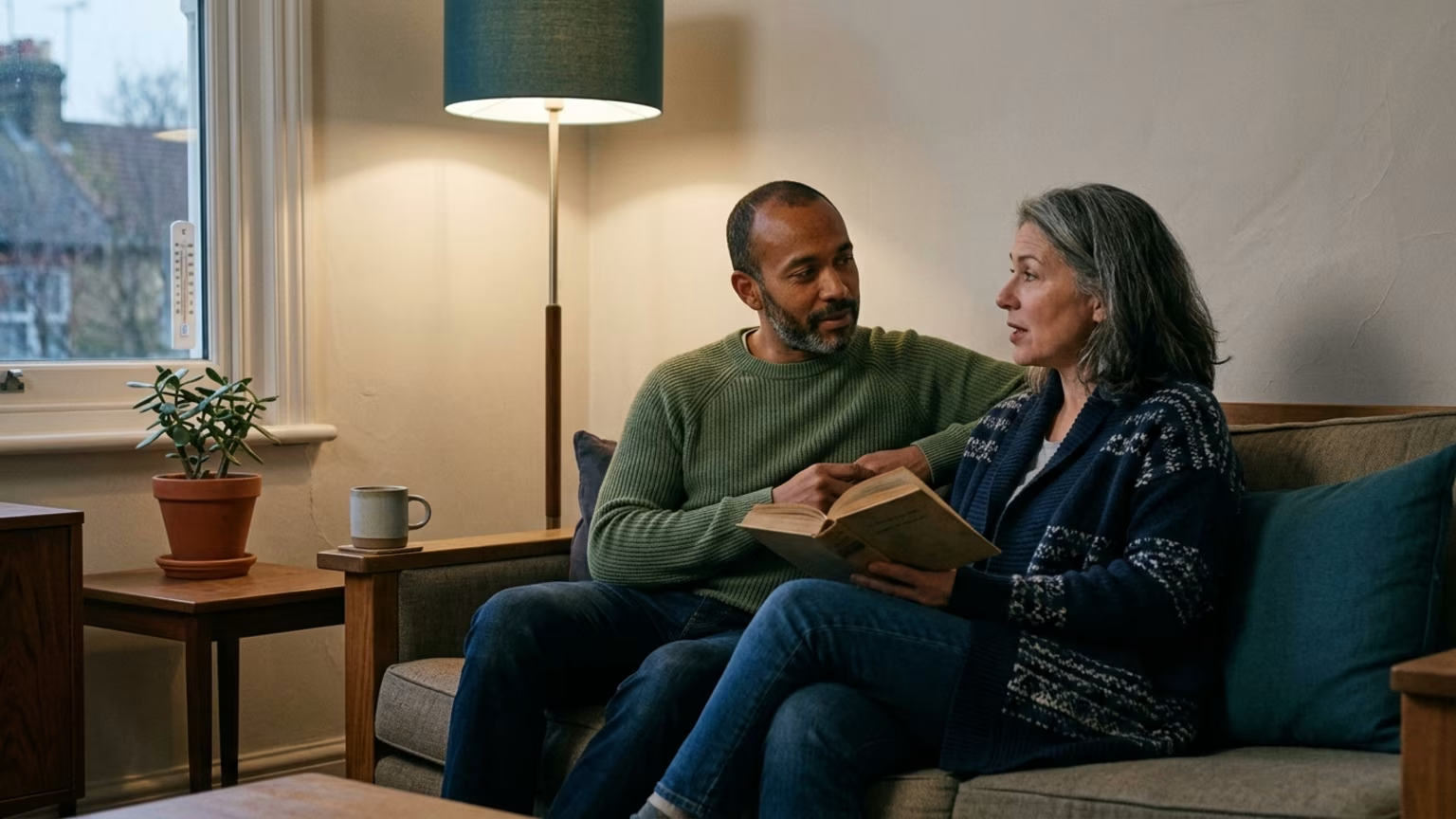
Environmental cues are not the only factors shaping rest in foraging societies. The BBC report details a shift from practical daytime activity toward nighttime storytelling, visiting, and campfires. This evening transition moves the community away from logistics, childcare, and food gathering. Anthropologist Alyssa Crittenden describes this evening pattern as a “nighttime cooperative niche.”
Within this niche, social connection and relaxed interaction may help mark the transition away from daytime demands. Preparing for rest involves more than just selecting a specific bedtime on a clock. It requires a tangible shift in social activity and mental effort to quiet the nervous system. For modern adults answering emails or managing household problems right before bed, this lack of transition can interfere with sleep preparation.
When the brain remains locked in a state of practical problem-solving, the physical signs of exhaustion are often ignored. The relationship between social connection and sleep extends into modern clinical research. A 2026 PLOS ONE study reported associations between loneliness, attachment-related factors, and sleep outcomes. Sharing a relaxed environment can provide a mental buffer against daily stress.
A common belief is that historical populations experienced eight hours of uninterrupted rest every night. The BBC challenges the assumption that a universally perfect night means eight uninterrupted hours. Crittenden views this expectation as physiologically unrealistic as a universal standard. Field data from foraging societies supports a much more varied picture of human rest.
The 2015 study recording 94 adults found approximately 5.7 to 7.1 hours of consolidated sleep. Furthermore, coverage of a 2026 Brain Medicine review reports roughly 6.4 to 7.1 hours of sleep in three societies without electric light. The review found no consistent evidence supporting a standard biphasic pattern of two long sleep periods. These groups do not routinely experience an extended period of wakefulness in the middle of the night.
Evolutionary anthropologist Gandhi Yetish cautions against expecting sleep to look identical every night. He compares normal sleep variation to the fact that people do not eat exactly the same food every day. Accepting normal night-to-night variation can reduce the anxiety many adults feel about their recovery metrics. Recognizing that better sleep and sleep quality naturally fluctuate helps adults maintain perspective.
Present-day foraging societies are not living fossils. Their sleep patterns cannot be treated as a complete record of how all human ancestors slept. The BBC explicitly acknowledges that knowledge of ancestral sleep is limited. Researchers use these contemporary societies as some of the best available evidence, rather than as direct measurements of prehistoric humans.
The finding that foraging groups report few sleep problems requires careful context. It should not be interpreted as evidence that these populations never experience fatigue or sleep disorders. Accepting some variation should not become an excuse to dismiss persistent daytime sleepiness, worsening insomnia, or loud snoring. Ongoing symptoms or major daytime impairment always warrant clinical advice.
The social aspects of sleep also require nuance before being applied universally. While many people in these communities sleep near intimate partners or children, shared sleeping has mixed results. Sleeping beside another person can introduce noise, movement, conflict, or mismatched schedules. The BBC does not claim that shared sleeping is universally beneficial for everyone.
Translating these findings into daily habits requires a realistic approach for adults navigating modern homes. The underlying field research identifies patterns associated with natural light, temperature, and social environments. It does not prescribe a universal bedroom temperature, as people differ in thermal comfort, health status, and housing conditions. These concepts are best framed as low-cost personal experiments.
Adults looking for ways of managing midlife stress and persistent fatigue can test these environmental signals safely. Integrating simple cues can support the body's natural transition into rest without requiring complicated protocols. The goal is to provide the physical signals that modern indoor environments often obscure.
Consider testing these evidence-based adjustments over several nights:
The most defensible trend context is that researchers are increasingly examining sleep as an interaction between light, temperature, seasonality, and social timing. Normal variation does not mean persistent insomnia should be ignored, but it does challenge rigid performance targets. As science moves away from treating bedtime as an isolated variable, how might these environmental insights change long-term approaches to midlife recovery?
Adjusting household temperatures and social routines to support natural sleep rhythms can feel overwhelming for busy adults, but letting Relaxopia analyze the environmental data clarifies your next steps. Our practical guidance cuts through the noise to help you manage uncertainty about sleep trackers, wearables and new recovery technology.
Stay connected for research-led guidance on sleep quality, stress, circadian rhythm, recovery, fatigue and everyday energy. Clear ideas for adults 35+ who want to sleep better, recover more fully and feel more capable through the day.




Explore practical guidance on sleep, stress and recovery without chasing every new hack, device or promise.
explore the blog