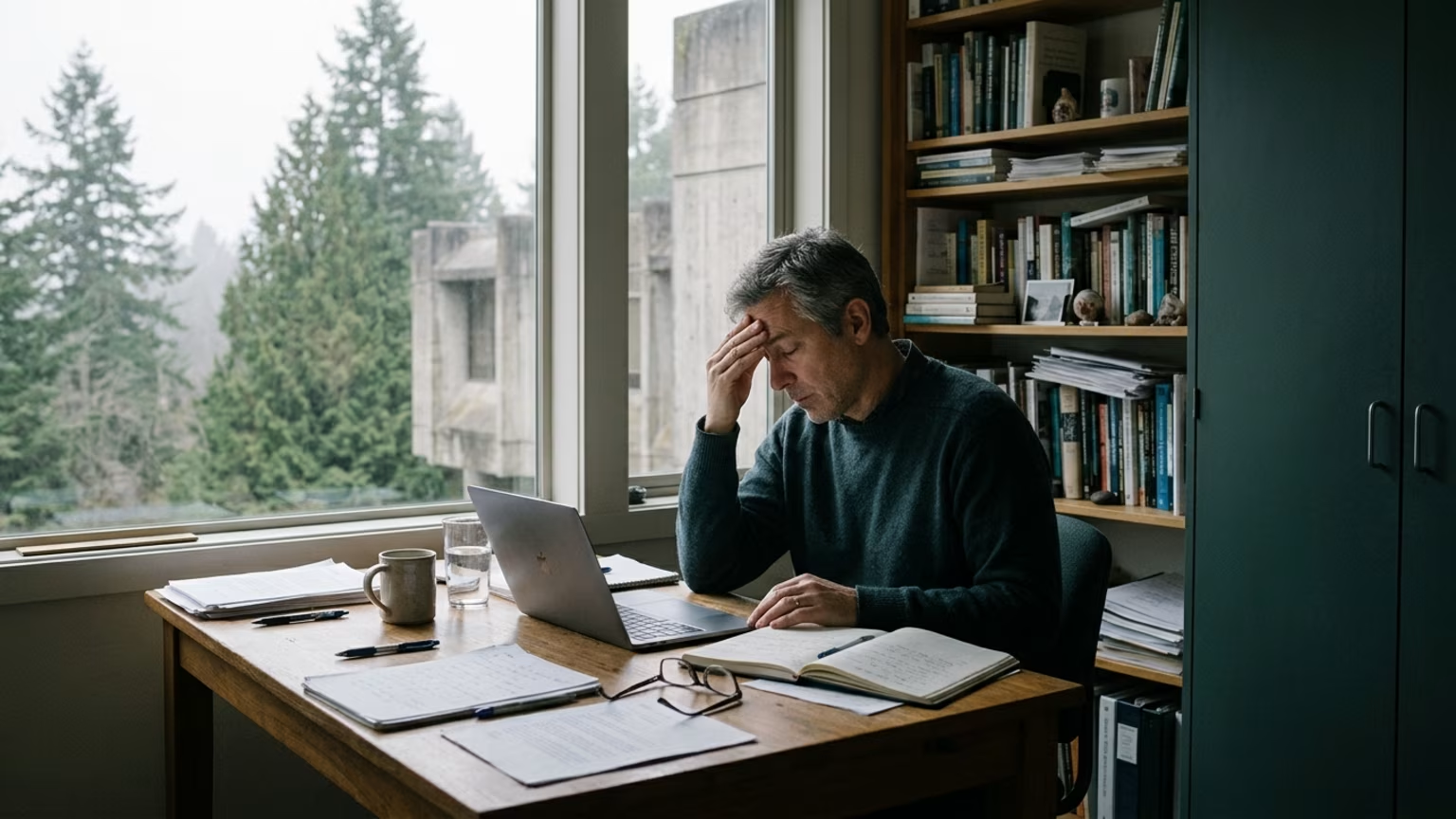

A small SFU MRI study found different responses to sleep loss by age. Understand the finding, its limits and a practical takeaway for midlife.





On October 29, 2026, Simon Fraser University reported that healthy younger and older adults showed different brain-network responses after a night limited to three hours of sleep. The study appeared in Imaging Neuroscience.
According to the university’s report, researchers used MRI scans to compare brain-network responses after a normal night’s rest with responses after the restricted night. Participants were healthy adults aged 20 to 30 or 65 to 75.
The groups showed opposite changes in some measured connections. Connectivity increased among younger participants and decreased among older participants after restricted sleep. That difference was the central finding.
The result raises an interesting question about aging: might brain networks respond to an unusually short night in different ways at different stages of adulthood? The researchers’ explanation focused on how those networks were organized rather than treating increased connectivity as automatically desirable.
That distinction matters when reading coverage of the study. The finding was a specific difference between age groups under controlled conditions. Understanding why the researchers found it interesting requires separating the observed change from their interpretation of that change.
In the university’s release, lead researcher Josh Neudorf interpreted the decrease in connectivity among older participants as consistent with more modular brain organization. He suggested that this arrangement could be more efficient.
For younger participants, Neudorf offered a different interpretation. Their increased connectivity could mean that their brains were working harder to maintain function after restricted sleep.
The observation and the explanation belong together, but they are not interchangeable. Researchers observed connections changing in opposite directions. Neudorf proposed that these patterns might reflect different ways of organizing activity after sleep loss.
The word efficient therefore needs careful handling. Here it describes a possible interpretation of a network pattern. It should not become a broad claim that aging makes poor sleep beneficial or that a brain scan provides a personal resilience rating.
A calmer reading is also a more accurate one: the study gives researchers an age-related pattern to investigate. It does not turn sleep restriction into a strategy for improving how the brain works.
CBC’s November 2 coverage described a small study involving a few dozen healthy participants. Nadia Gosselin, a sleep researcher at the University of Montreal who was not involved in the research, cautioned that a controlled experiment may not reflect people who regularly struggle with insufficient sleep. Its findings should not be extended to persistent insomnia or poor sleep shaped by health conditions and caregiving demands.
The age bands also leave a gap for midlife readers. The study compared adults aged 20 to 30 with adults aged 65 to 75. It did not establish how the response changes across the intervening years or identify an age when one pattern becomes another.
The researchers measured brain activity rather than directly testing cognitive performance. The results do not establish that older participants retained their memory or attention after the short night. Nor do they demonstrate preserved mood or better everyday decision-making. A potentially efficient network arrangement is not proof of better functioning.
Finally, the experiment concerned one restricted night compared with a normal night’s rest. It did not establish the consequences of repeated short nights or chronic sleep problems. These are separate questions from how brain connectivity responds to an acute restriction.
For someone in their late thirties through their mid-sixties, the practical adjustment is modest: include daytime functioning in how you think about your rest. Rather than using age as reassurance, notice whether poor nights are followed by recurring difficulties that matter in ordinary life.
A brief check-in can focus on questions already relevant to the research’s practical implications:
This is a way to describe your experience rather than diagnose it. The purpose is to notice a pattern clearly enough to decide whether it deserves professional attention. A simple description serves that purpose without turning recovery into another performance score.
For example, identifying repeated difficulty concentrating gives you something concrete to discuss. Deciding that your brain must belong to the more efficient group does not. The useful shift is from guessing about an unseen network response to describing what you are actually experiencing.
Relaxopia’s discussion of looking at daytime recovery patterns offers related context for thinking about fatigue without reducing it to a single measurement.
CBC reported Gosselin’s guidance that middle-aged adults typically need seven to nine hours of sleep per night. For older adults, she gave a range of seven to eight hours. These ranges were her guidance as reported by CBC, not recommendations established by the MRI experiment.
That distinction keeps the practical message grounded. A sleep-duration range provides context for thinking about an ordinary schedule. It is not a personal prescription or a reason to disregard persistent symptoms because the hours appear to fit.
Neudorf and co-author Brianne Kent stressed that the findings are not a reason to skip sleep. The university’s release also stated that chronic, long-term sleep loss is detrimental to brain health and cognitive ability. Good-quality sleep remains important throughout life.
For a reader balancing work and family responsibilities, the takeaway is not to pursue a lower sleep target with age. It is to keep adequate rest in view while taking recurring daytime problems seriously. An interesting age comparison does not make those problems less deserving of attention.
If poor sleep and daytime difficulties persist, discuss them with a qualified health professional. A useful starting point is a description of what has been happening at night and what has become difficult during the day.
You might describe whether short nights keep recurring or whether concentration problems are interfering with ordinary tasks. The aim is to communicate the pattern rather than arrive with a theory about brain connectivity. Personal decisions about persistent sleep difficulties belong in that broader clinical conversation.
This approach does not require an elaborate monitoring routine. It keeps the focus on the concerns already present: sleep that is repeatedly poor and daytime functioning that does not feel restored. It also leaves room for professional assessment rather than asking a research headline to explain an individual situation.
For an isolated rough night, Relaxopia’s guide to thinking through the following day addresses a related practical concern. The useful distinction is between responding to an occasional disruption and seeking support for something that keeps happening.
The next research step is to connect these imaging patterns with outcomes people can recognize in daily life. Future work could examine adults across middle age while measuring attention and other aspects of functioning alongside brain-network responses. It could also investigate how responses differ when sleep disruption recurs.
That would help clarify whether the proposed efficiency has a meaningful role in recovery beyond the scan itself. For now, the finding offers a focused research question rather than a new rule for how much sleep to pursue.
Could future studies connect age-related brain responses with everyday functioning well enough to guide more useful long-term approaches to midlife recovery?
Concentration and energy after a short night offer a practical focus for understanding recovery beyond an intriguing brain-scan result. Relaxopia translates credible sleep and fatigue research into clear guidance for adults 35+ while distinguishing established evidence from early findings and keeping uncertainty visible without adding unnecessary complexity.
Stay connected for research-led guidance on sleep quality, stress, circadian rhythm, recovery, fatigue and everyday energy. Clear ideas for adults 35+ who want to sleep better, recover more fully and feel more capable through the day.





Explore practical guidance on sleep, stress and recovery without chasing every new hack, device or promise.
explore the blog