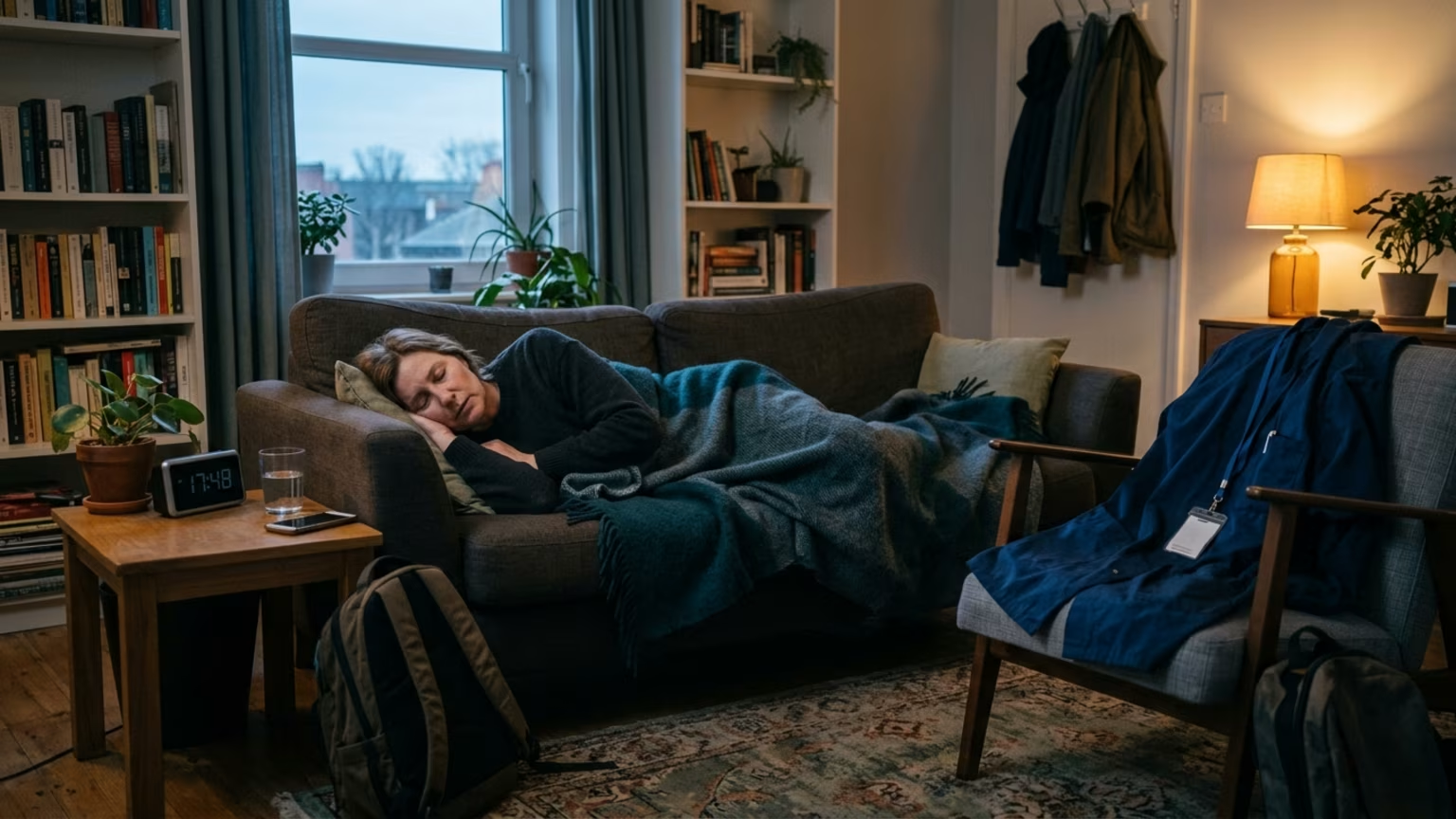

A new guide reviews longer naps before night shifts. Learn what the study examples suggest about timing, length and allowing time to wake fully.





On October 12, 2026, Capillary Health published a practical guide to napping before overnight work that summarized research on longer pre-shift naps and alertness. Updated October 13, 2026, the guide addressed nap timing and length rather than reporting a new clinical trial.
The guide’s central point is that a longer nap before overnight work may reduce sleep pressure. Sleep pressure is the drive to sleep that builds while a person is awake. Taking sleep before the shift is intended to lower that accumulated pressure before the working night begins.
The guide describes this approach as a “prophylactic nap.” In plain language, that means sleeping ahead of an expected period of overnight wakefulness rather than waiting until sleepiness becomes difficult to manage.
This has a different purpose from a brief nap taken for a short-lived lift in alertness. According to the guide, a brief nap may help for a couple of hours. A longer pre-shift nap is intended to support alertness across more of the night by reducing sleep pressure beforehand.
That distinction matters when reading nap advice. A recommendation aimed at getting through a temporary afternoon dip answers a different question from research about preparing for overnight work. Relaxopia’s discussion of how daytime rest fits alongside the main sleep period provides related context for that difference in purpose.
The guide summarized studies using naps of 1.5 to 3 hours before a night shift. Its reported examples included both afternoon and evening sleep opportunities:
These examples help explain what the guide means by a longer pre-shift nap. This is a planned block of sleep before overnight work, not simply a brief pause close to the start of a shift.
The useful detail is not only how long participants slept. Each example also identifies when that sleep occurred. Duration and placement belong together when interpreting the findings: a nap lasting several hours occupies a substantial part of the afternoon or evening.
The guide identifies the afternoon around 14:00 to 16:00 as a period of increased sleep pressure. It also describes late morning from 11:00 to 12:00 as a time when falling asleep may be harder. The same difficulty may occur during the 1 to 3 hours before a person’s usual bedtime.
This helps explain why scheduling a nap is not just a matter of finding an empty space on the calendar. The guide distinguishes between having time available and having a period when sleep may come more readily.
The evening study example still reported an alertness benefit. That finding sits alongside the guide’s broader timing discussion rather than cancelling it out. One describes an outcome in a particular study setting; the other describes general patterns in the ease of falling asleep.
For readers sorting through these timing questions, Relaxopia’s coverage of daily rhythms and sleep schedules offers a broader editorial starting point. Here, the immediate question remains narrower: where might a longer sleep opportunity fit before overnight work?
The guide also summarized a 2006 study that examined an evening nap before the first two of four night shifts. That study included separate laboratory and field components.
According to the summary, the laboratory portion included 68 people. Nap, caffeine and nap-plus-caffeine conditions each improved alertness and performance. The combination produced the best results in that laboratory setting.
The field portion included 53 shift workers. The guide reported improved performance and lower sleepiness with nap plus caffeine.
These findings add another part to the research picture: investigators have examined pre-shift sleep alongside other approaches to alertness. They also show why the question is broader than choosing a nap length alone. The reported outcomes concerned both how sleepy people felt and how they performed during work-related testing.
The three nap schedules were not tested against each other in a single standardized trial. They do not establish one best schedule for every worker or show that the longest option is better. The evidence also does not establish equal results across ages, occupations, shift patterns or health circumstances. There is no special nap formula for adults 35+ in these summaries.
For the 2006 study, the guide did not provide the precise nap duration or clock time. It also omitted participant characteristics and numerical effect sizes. Those gaps limit how far its favorable nap-plus-caffeine findings can be translated into a practical schedule or caffeine recommendation.
Research on naps taken during a shift is a separate question. The guide described an on-shift trial involving 49 emergency-department physicians and nurses. Participants had less fatigue and sleepiness plus fewer vigilance-test lapses later in the shift. They also had briefly worse memory immediately after the nap and no improvement in simulated driving home.
The guide’s summary of a 2016 review rated on-shift nap trials low or very low quality and inconclusive. It also cited a 2014 review that found no study measuring workplace safety. Better alertness in a study should therefore not be treated as proof that workplace naps make every task or the journey home safer.
Taken together, the material supports a longer pre-shift nap as a possible aid to alertness. It does not support replacing adequate sleep with a nap or treating one as a guaranteed answer to fatigue.
For an adult aged 35 to 65 who works overnight, the clearest daily adjustment is to plan for two things: the sleep opportunity and the period after waking. Fitting a nap into the day is only part of preparing for the shift.
The guide cautions that waking from sleep can leave a person groggy. This is often called sleep inertia. Its practical advice is to allow that grogginess to clear before work or other critical tasks.
A simple planning approach can keep the evidence focused:
This shifts the practical question from “Which published nap time should I follow?” to “Is there room for sleep before this shift and time to become fully awake afterward?” It keeps attention on the full transition into work rather than on the sleep block alone.
The same distinction applies when reading advice about caffeine. A favorable study result is evidence to understand, not a personal instruction to combine caffeine with a nap. Decisions involving individual health circumstances or persistent difficulty staying alert are best discussed with a qualified clinician.
For someone balancing overnight work with daytime responsibilities, this is a planning adjustment rather than another performance target. The aim is to make room for recovery where possible without turning one study schedule into a test of whether someone is resting correctly.
The next useful step would be research that connects pre-shift sleep with recovery across repeated working nights. Alertness during a shift matters, but a longer-term approach would also ask how the nap fits with the worker’s main sleep and everyday responsibilities.
For adults in midlife, that would make the evidence more useful than a single recommended clock time. It would move the discussion toward sustainable arrangements for recurring overnight work.
Could future studies show how pre-shift naps fit into a lasting approach to midlife recovery rather than remaining a strategy assessed mainly through alertness during individual shifts?
Choosing where a pre-shift nap fits in the working day calls for clear evidence, and Relaxopia puts that choice in context through its sleep and recovery reporting. Its coverage addresses conflicting advice about naps and caffeine so adults in midlife can approach everyday rest with clearer expectations rather than another rigid routine.
Stay connected for research-led guidance on sleep quality, stress, circadian rhythm, recovery, fatigue and everyday energy. Clear ideas for adults 35+ who want to sleep better, recover more fully and feel more capable through the day.





Explore practical guidance on sleep, stress and recovery without chasing every new hack, device or promise.
explore the blog