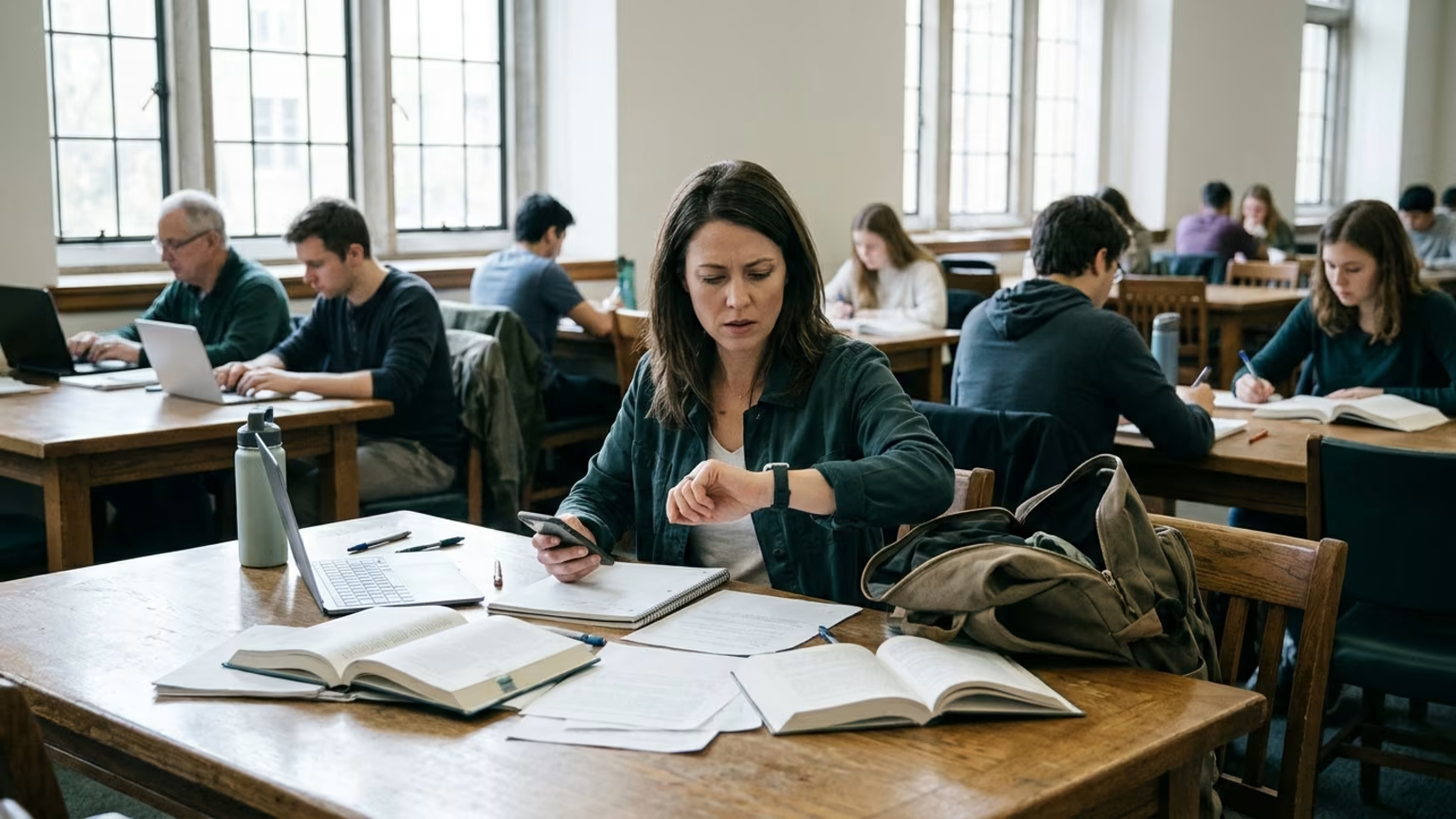

A study of 646 undergraduates separates time pressure from a full schedule, with reflection prompts and clear limits for adults in midlife.





On September 30, 2026, CU Boulder Today reported on a University of Colorado Boulder study published in the Journal of American College Health that separated having little free time from feeling rushed. The study surveyed 646 undergraduates about their schedules, mental health and mindfulness.
The amount of free time students had and the pressure they felt did not tell the same story. According to CU Boulder Today, students with busier schedules were less likely to report depression and tended to have better grades. Students who felt chronically rushed showed higher anxiety and depression and lower grades, regardless of how full their schedules were.
The researchers separated two experiences that everyday conversations about stress often place together:
The survey assessed anxiety and depression alongside mindfulness. According to ConsumerAffairs, the researchers also considered students’ academic records. That allowed the reporting to describe both mental-health associations and differences in grades.
Mindfulness added another layer. CU Boulder Today and ConsumerAffairs reported that students with higher mindfulness scores appeared to experience fewer negative mental-health associations with time pressure.
The useful distinction is between the demands on a schedule and the experience of moving through that schedule. Counting commitments addresses one question. Asking whether life feels like a continuous race addresses another.
These were associations rather than proof of cause and effect. They do not establish that busyness improved mental health or that feeling rushed caused anxiety, depression or lower grades. ConsumerAffairs notes that students who already felt better may have been more likely to pursue activities, while other factors could have shaped both time perception and emotional well-being.
The sample consisted of undergraduates. The available coverage does not provide effect sizes or detailed participant demographics, including student ages. It therefore leaves the size of the associations and their relevance to midlife adults unresolved.
The mindfulness finding was not evidence that a tested mindfulness practice produced better outcomes. The reported results also do not establish effects on sleep, physical health or recovery. Those boundaries matter when translating this finding into everyday advice.
Speaking to ConsumerAffairs, researcher Caitlin McKimmy said: “The amount of time we have in our week isn’t super malleable. But the way we think about time is.”
Her interpretation directs attention beyond the number of items on a calendar. It invites a question about the relationship with time itself: does the day feel manageable, or does it carry a recurring sense of falling behind?
That distinction needs careful handling for someone with little control over working hours or caregiving demands. A real shortage of time remains a real constraint. Looking at perceived hurry should widen the discussion of strain rather than turn it into a judgment about someone’s attitude.
The point is not that commitments never need to change. It is that calendar changes and the experience of time are separate questions worth examining.
For an adult aged 35 to 65, the practical adjustment is not to add activities or build a new productivity system. It is to distinguish a shortage of available time from a persistent sense of being behind. When rushing becomes noticeable, a useful reflection prompt is: Is there too much to fit, or do I feel hurried while doing what fits?
That question leaves room for both answers. It also avoids treating every difficult day as either a scheduling failure or a failure to stay calm.
Start with the actual demands rather than assuming the problem is perception. The study’s definition of time scarcity concerned how much uncommitted time remained after activities. For a midlife reader, the corresponding reflection is whether existing obligations leave realistic room for anything else.
Where commitments do not fit, that deserves recognition. A breathing pause does not create more available time. It would be unfair to label a genuine workload problem as a lack of mindfulness.
The finding about busier students is also not an invitation to fill remaining gaps. A schedule should not become fuller simply because this sample showed an association between busyness and lower depression. The practical question is whether commitments fit the person’s circumstances and priorities, not whether more activity looks better on paper.
The other question concerns the recurring experience of rushing. Is the pressure connected to a specific demand, or does the feeling of not keeping up seem to accompany whatever is happening?
ConsumerAffairs suggests pausing to breathe and refocus on the present. As an everyday reflection habit, that can mean noticing the current task and asking what is actually demanding attention now. The aim is observation rather than forcing a particular mood.
This need not become a scored exercise or another standard to meet. There is no requirement to feel calm before continuing with the day. The distinction is useful when it makes the experience clearer, not when it becomes another reason for self-criticism.
For a related perspective on examining an interpretation without demanding positive thinking, see the guide to thinking more flexibly about stress.
ConsumerAffairs also suggests choosing activities that fit personal interests and values. That offers a different question from simply asking how much can be removed from the calendar.
When reviewing a commitment, the reflection can include whether it matters personally rather than only how much time it takes. A meaningful activity and an unwanted obligation should not automatically be treated as interchangeable blocks of busyness. The point is to examine fit rather than use an empty calendar as the sole measure of a manageable life.
This is not a demand to justify every activity or turn rest into a planning exercise. It is permission to ask a more useful question than whether a week looks busy. The study’s distinction leaves room to discuss both the amount of activity and the pressure surrounding it.
Mindfulness should not become a test of whether someone is handling life correctly. Persistent anxiety or depression deserves attention from a qualified health professional rather than repeated attempts to solve it through calendar changes or self-reflection alone.
For readers also concerned about poor sleep or low energy, those concerns belong in the discussion in their own right. They do not need to be squeezed into a single explanation about time pressure.
A related discussion of returning to baseline after stressful demands keeps attention on recovery rather than treating constant calm as the goal. That is a useful editorial boundary here too: the aim is clearer understanding of strain, not perfect control over every feeling.
A useful next step for research would be to examine calendar demands and perceived hurry together in adults 35+. Future studies could compare changes to commitments with approaches aimed at the recurring experience of time pressure. They could also directly assess sleep and recovery rather than infer them from mental-health measures.
For now, the distinction offers a more precise starting point for a conversation about overload. The calendar describes what is scheduled. The feeling of hurry describes how moving through those demands is experienced. Keeping both in view avoids making either the schedule or the person’s outlook the automatic explanation.
Could future research show that addressing persistent hurry alongside real workload constraints leads to more useful long-term approaches to recovery in midlife?
Deciding whether to change commitments or examine a persistent sense of hurry is a practical judgment; Relaxopia supplies research-based context for that choice. The publication translates credible evidence about stress and everyday rest into clear guidance for readers in midlife, without prescribing complicated routines or making medical promises.
Stay connected for research-led guidance on sleep quality, stress, circadian rhythm, recovery, fatigue and everyday energy. Clear ideas for adults 35+ who want to sleep better, recover more fully and feel more capable through the day.





Explore practical guidance on sleep, stress and recovery without chasing every new hack, device or promise.
explore the blog