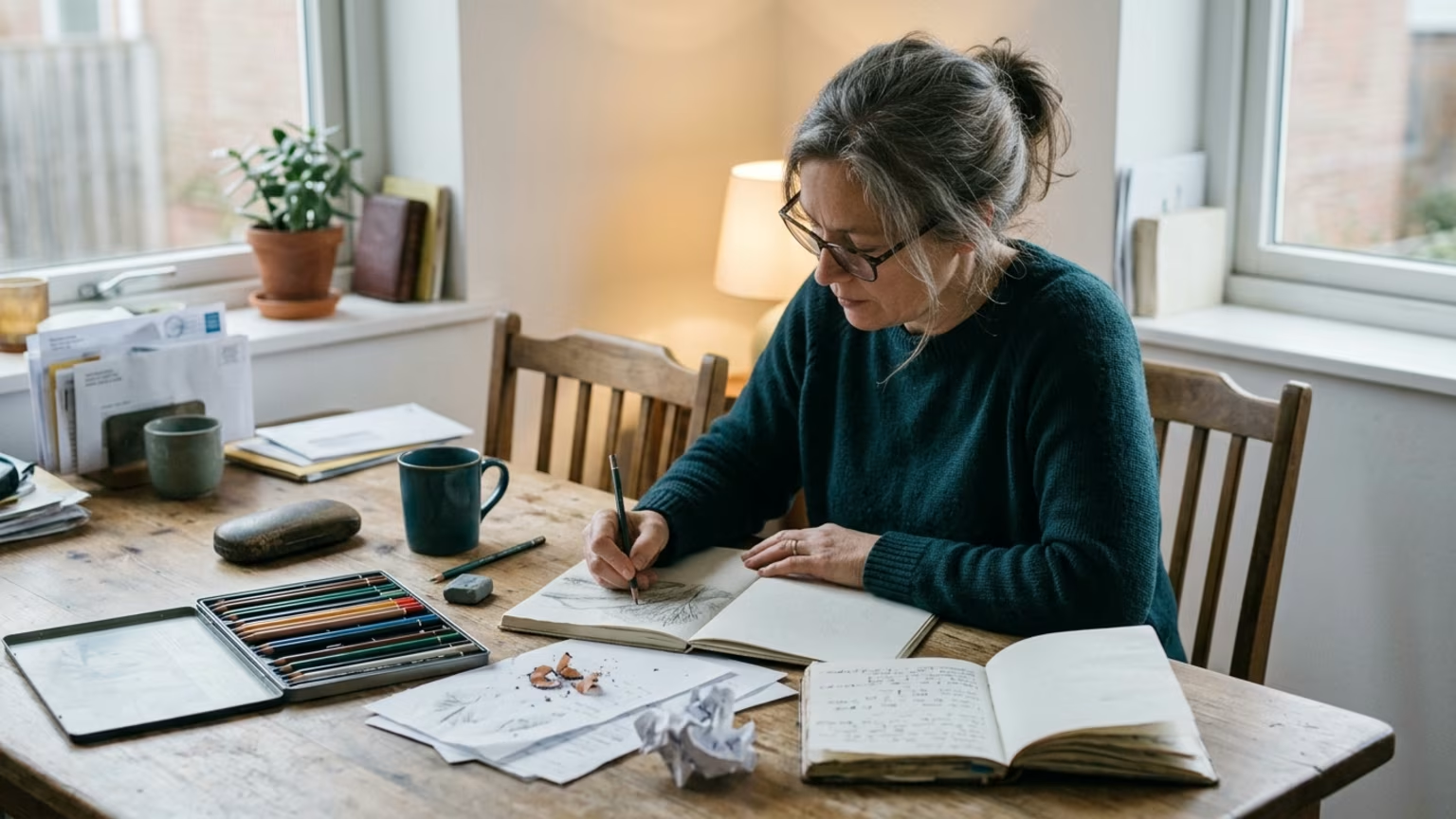

A small study reported less anxiety after drawing, but no significant cortisol decrease. Here is a measured look at creativity as a short-term pause.





On September 29, 2026, Deccan Herald reported on a study in which 48 healthy adult women completed a laboratory stress task and then drew with oil pastels or on a digital tablet.
In the study as summarized by Deccan Herald, anxiety decreased after both drawing activities. Cortisol did not decrease significantly. The central finding is therefore about a reported change in anxiety, not a consistent change across every measure of stress.
That distinction is useful because feeling calmer and showing a change in a physiological measure are different outcomes. The report explains that anxiety, cortisol and measures such as heart rate or blood pressure need not move together. Stress is not a single switch that turns off all at once.
For someone seeking a pause after a demanding moment, a reduction in anxiety is a relevant finding. It concerns the experience of distress rather than only a laboratory measurement. But interpreting that experience requires keeping it separate from claims about what happened elsewhere in the body.
The most accurate reading is narrower than saying that creativity resets the nervous system. The women reported less anxiety after drawing. The physiological result was different, and the account gives no basis for treating either finding as a complete picture of recovery.
Deccan Herald places the drawing experiment beside earlier research on creative activity. It describes a 2016 study in which 39 healthy adults made art for 45 minutes. Materials included markers, modeling clay and collage supplies. Cortisol fell significantly after the session.
That earlier study did not include a laboratory stress task, according to the report. Its question was therefore different from asking how people recover after experimentally induced stress. The two studies belong in the same discussion, but their activities and circumstances should remain distinct.
The music research in the article shows why that distinction matters. A 2019 analysis of 104 randomized controlled trials involving 9,617 participants found overall effects on psychological and physiological stress measures. A later review of 14 studies focused specifically on music listening during recovery from experimentally induced stress. It found no significant overall effect.
Those findings need not be reduced to a verdict that creative activities either work or fail. A broad question about stress and a focused question about post-stress recovery are not interchangeable. The report's examples support asking which activity was studied, in whom and against which outcome.
They also help explain why a promising headline should lead to a closer look rather than a universal recommendation. Drawing, music and other creative activities share a broad category. That category alone does not make evidence from one activity a result for all the others.
The Deccan Herald account does not identify the drawing study's authors, journal or DOI. The underlying paper and its methods therefore cannot be independently checked from that report alone. This is a news account of research rather than a directly assessable primary study.
Several details needed to judge the result are also absent:
Without those details, the account does not establish how much of the anxiety change can be attributed specifically to drawing. It also does not establish an ideal session length, a better drawing medium or how long any change lasted. These gaps limit interpretation rather than supplying a reason to fill in a routine from guesswork.
The participants were healthy adult women. The report provides no age-specific findings for adults 35+ and does not represent the wider population experiencing persistent stress or health conditions. The earlier cortisol study was also small and does not establish that art-making always lowers cortisol.
The boundary around health outcomes is equally clear. Deccan Herald cautions that short-term stress findings do not show that drawing prevents heart disease or provides lasting cardiovascular protection. The report also contains no sleep outcomes or evidence that creative activities improve sleep.
For an adult between 35 and 65, the practical implication is modest: drawing can be an optional activity after a stressful moment. It does not need to become a daily requirement or another measure of how well someone manages life. The reasonable expectation is a chance to feel calmer in the moment.
The report frames creative activity as a possible way to focus attention, express emotion or become absorbed in an activity. That offers a useful starting point for choosing an activity. The purpose is an available pause rather than producing something impressive or completing a recovery assignment.
A low-demand approach could look like this:
These are ways of keeping the idea practical, not a clinical protocol. A creative pause can sit after a difficult interaction or at the point when a demanding part of the day ends. There is no need to label that moment as a treatment session.
If drawing feels like another obligation, the article offers no reason to force it. The value of the suggestion lies in its optional nature. Recovery does not have to include every promising activity, and choosing not to draw is not a failure to take stress seriously.
A creative pause belongs beside the rest of everyday recovery rather than above it. Deccan Herald positions arts activities alongside established health practices and appropriate care. Drawing should not displace sleep, exercise or nutrition, and it is not a substitute for medical care.
For a reader whose main difficulty is moving from demands into downtime, the relevant question may be where a creative pause could fit. Relaxopia's discussion of the shift from a demanding day into rest offers a related way to think about that transition. It need not become an additional task to complete before resting.
For someone focused on low daytime energy, keep that concern visible rather than replacing it with a drawing target. A calmer activity and a clearer understanding of fatigue serve different purposes. Reading about how to describe tiredness and mental overload more accurately can provide another starting point for that discussion.
Readers interested in the wider topic can also turn to USU's article on everyday creativity and mental health. That broader reading can sit alongside the specific laboratory finding without treating every form of creativity as the same intervention.
When ongoing stress or poor sleep is the concern, personal decisions belong with qualified care. A creative activity can remain part of ordinary life while those concerns receive attention. It does not have to carry the burden of solving them.
The next useful research questions are more specific than whether art is good for health. Future studies could ask how a drawing pause compares with other ordinary recovery activities. They could also examine whether any benefit remains meaningful beyond the immediate session and which outcomes matter most to participants.
For midlife readers, research that includes everyday pressures and daytime functioning would be particularly relevant. Feeling less anxious after an experiment is one question. Having a manageable activity that fits alongside work, caregiving and adequate rest is another. Connecting those questions would make future findings easier to use.
Could a creative pause become a useful part of long-term midlife recovery without becoming another habit people feel pressured to perform?
Creative activity sits beside sleep and health care rather than replacing them, a boundary that fits Relaxopia's evidence-focused editorial approach. Readers facing low daytime energy or inconsistent recovery can use its reporting on sleep, stress and fatigue to understand which everyday habits deserve attention without taking on a complicated recovery routine.
Stay connected for research-led guidance on sleep quality, stress, circadian rhythm, recovery, fatigue and everyday energy. Clear ideas for adults 35+ who want to sleep better, recover more fully and feel more capable through the day.





Explore practical guidance on sleep, stress and recovery without chasing every new hack, device or promise.
explore the blog